Last weekend C and I took a mini-trip to Arizona so I could run my first race of the year, Aravaipa’s Black Canyon 100K.
We took Friday off and hit the road early, arriving at the packet pick up/expo by 4:30 p.m. From there we headed up to the cabin we were staying at for the night, which was just a few minutes from the start line.
Race Day
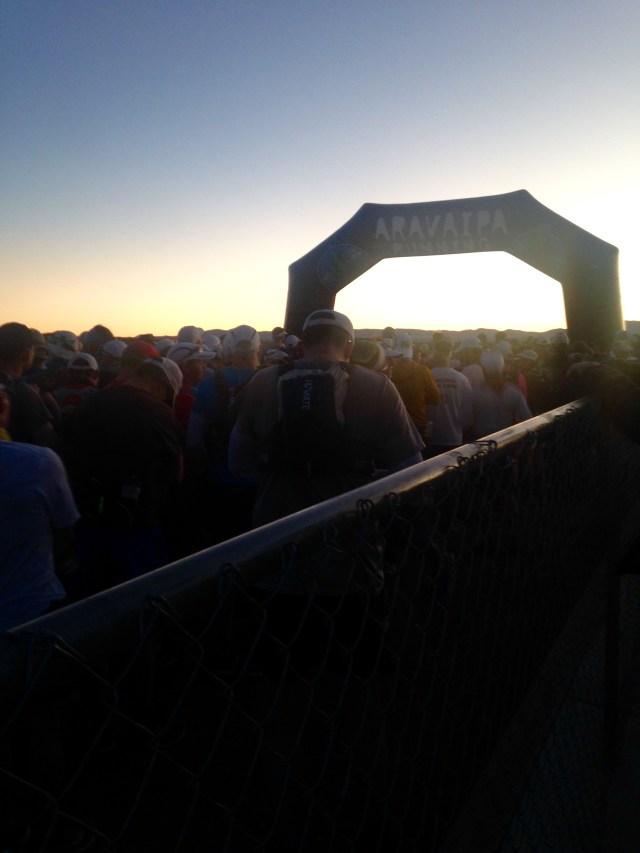
Staying close to the start really paid off. I was able to “sleep in” and get to the start with plenty of time to spare. The field was BIG, with more than 200 people starting the 100K—and another 60+ runners in the 60K, which would start an hour after the 100Kers.
As we were all waiting in the high school, I couldn’t help but comment on what a well-organized event this was already turning out to be! Not only were we able to wait in the school—we were treated to flushing toilets, coffee, cinnamon rolls, and more. I ran into a few local San Diego running friends, wished them well, and then headed out to the start.
Off and running
The race starts with a lap around the high school track before runners embark upon their 100K point-to-point journey on the Black Canyon National Recreation Trail. Temps were forecasted to be hot … and they didn’t disappoint.
In my usual fashion I settled in toward the rear and focused on finding that smooth, steady pace for the day. Before I knew it I was through mile 15, things were feeling great, and, for the first time I was well ahead of schedule.
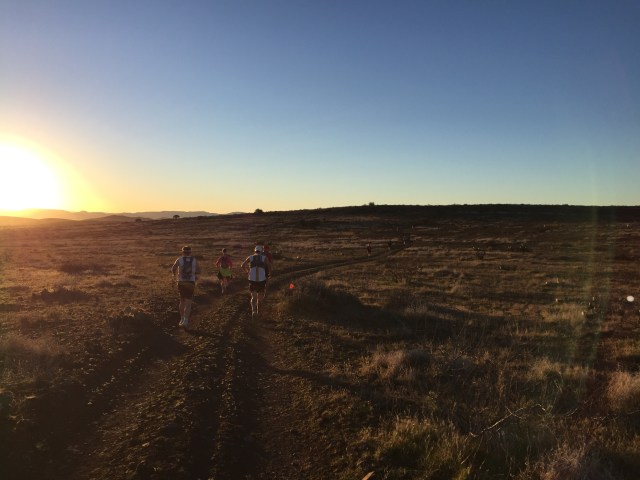
Runners at the startThe course is a Western States Qualifier that features a deceptively challenging elevation profile.Out for a long day (somewhere around mile 6)
Getting ugly
There’s a saying in ultrarunning: “If you start to feel good during an ultra—don’t worry, you’ll get over it.” While I always thought I knew what that meant, it took on an entirely new meaning in this race, and it started around mile 17.
I’ll spare the details, but for the next 15miles I had some of the worst G.I./stomach issues I had ever experienced while running. This slowed me to a crawl, and as temperatures continued to rise, my spirits began to sink.
Things had quickly turned into a hot, miserable day in the desert.
Despite the fact I was well off my goal pace, I kept moving forward, all the while trying to fix my issues on the move. Was it nutrition? There was a bug floating around my office all week that had taken a few people out—was that it? Maybe it was just the heat? I don’t really know, but, eventually—almost 15 miles later—I started to feel like myself again.
… I couldn’t believe it. I’d kept myself moving.
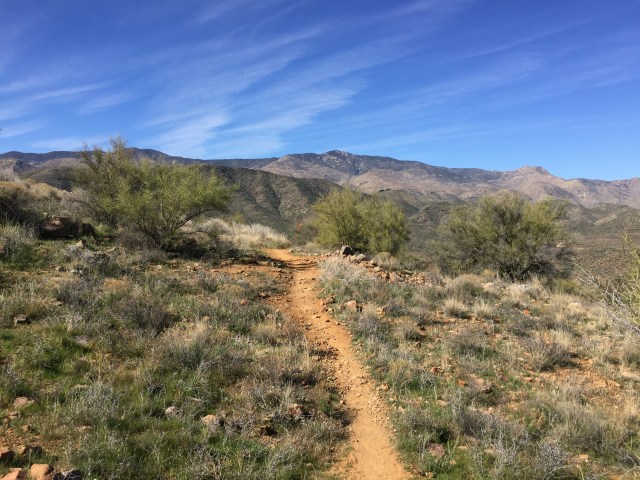
I take it back. There was one good thing during this time. The views.
If there was any benefit to shuffling along the first 30 miles, it would be that my legs were pretty “fresh” for the back half. I came into Black Canyon aid station, quickly refueled, and headed back out.
I’d heard a lot of people talk about the challenges of the back half of the course. I quickly found out their warnings were valid. There were several significant climbs and multiple stream crossings that felt GREAT given the heat, but were a bit much on my feet.
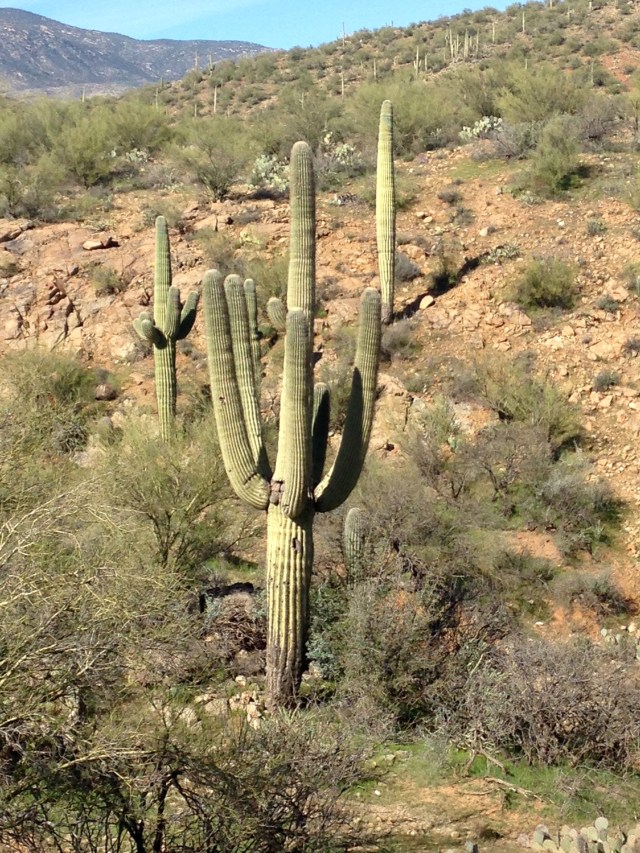
Giant saguaros lined the course most of the way
Back in the saddle
At mile 45, I was back and feeling great much better. Though my initial goal had gone out the window, I realized I still had a shot at finishing under 17 hours, which would give me a Western States qualifier, but I would have to push it. Hard.
This was a defining moment for me. I battled those thoughts that said just getting to the finish would be “good enough” and that I could justify my finish since the first half of my day went so terribly. I said no.
Instead, I decided to push it.
Bringing it home
The last 15-18 miles were a bit of a blur. I had my music going and a goal on my mind. Before I knew it I was crossing the finish in 16:33.
I’d beaten my stomach issues.
I’d beaten the heat.
But most importantly, I beaten the cruel voice of complacency that can sneak into your head when the day doesn’t go your way.
What just happened?With my better half at the finish
Post-race thoughts
Though I don’t know exactly what caused my stomach issues, I do have a few ideas that I’m looking into. Regardless, this still ranks as one of my more memorable races.
Ultras are such a journey. They’re a journey of the body, the mind, and even the soul. And just like any journey, there will be ups and downs, with the real test being how you manage them. For me, I could have given up and said “Meh, not my day. Stomach problems got the best of me.” But that’s not in my nature. Instead, I chose to stick it out—to stay in the fight. I’m glad I did, because I learned much more about myself by doing so.
Thoughts on the race: This was my first Aravaipa Running race and it was fantastic. Everything—from the packet pick up expo, to pre-race amenities, aid stations, course markings, and the finish line party were all top notch. I can’t wait to come back and run another one of their events.
I was so excited to get back up to Big Bear. If you remember last year, I had planned on running the Kodiak 100 to avenge my DNF at the San Diego 100. Well, a year later (and WISER!), I realized how glad I was that didn’t happen, because Kodiak would have eaten me alive.
The facts are the Kodiak races are incredibly challenging – and in looking back, I can honestly say I wouldn’t have been ready. I needed another year of experience under my belt. And now I had it.
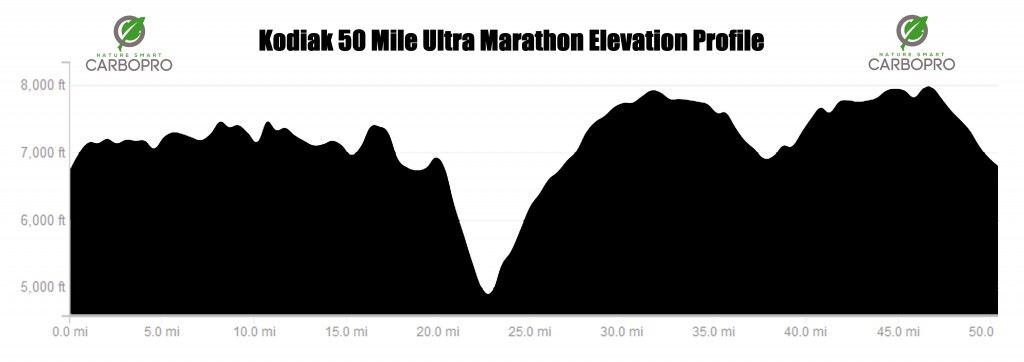
Kodiak 50-Mile Course Profile
Arriving in Big Bear
I went to Big Bear last year to train for a weekend, but this was going to be C’s first time up here. I was excited for her to experience the mountains.
We arrived early Friday afternoon, checked in at the race headquarters and walked around talking to several of the vendors who were there at the expo. CarboPro, Altra, Orange Mud, Clif Bar, Feed the Machine, and more were all in attendance – as well as members of the Tarahumara who were selling homemade items to help raise money for their families and to cover race expenses. I spent some time talking with a few of them and ended up buying a pair of authentic, homemade running sandals from them. They are amazing and I have them displayed on my “running wall” at home.
Race Day
The 50-mile race started on the north side of the lake at the Hana Flats aid station. C drove me around the lake to the start, and after hanging around for about 20 minutes, we were off. I knew even before the race started that the elevation would be a factor for me (the majority of the race is run at 7,000 feet or higher). Knowing this, I planned to settle into a consistent, controlled pace and pay close attention to how I was feeling. As we ran, runners were greeted by an unbelievable sunrise over Big Bear Lake.
I knew right then that the race was going to be a good one.
Sunrise over Big Bear LakeTrail leading into Snow Valley
Settling in
The first 15 miles went very smooth. I stayed conscious of my breathing and settled in to enjoy the views. By the time I got to Snow Valley Aid Station, I was feeling still feeling good and a bit ahead of schedule. Having CarboPro at all of the aid stations was a huge win, since that is what I normally train with.
I refueled and headed out from Snow Valley and toward what I had heard over and over was the crux of the course: Siberia Creek Canyon. Needless to say, it lived up to the hype.
At the top of Siberia Creek
After descending into the canyon and reaching the bottom, runners passed through an aid station before beginning the long, 3,000-foot climb up the other side.
Aid station at the bottom of the canyon
Siberia Creek was beautifully brutal.
As beautiful as it was, the climb out WENT. ON. FORVER!
Climbing out of Siberia Canyon
Once out of the canyon, I arrived at Champion Aid. My climbing had been efficient and controlled, so I was still feeling strong. But things were about to get even better because we were about to run on one of my favorite sections of single track: The Skyline Trail.
As the sun fades away
The views from the Skyline Trail were absolutely unreal. And the fact that it was sunset made for some views that will be with me for a lifetime. My phone was dead by this point so I didn’t get any pictures – but in retrospect, it was better that way. I ran in silence and just took it all in. And it was perfect.
As darkness settled in, so did an increased level of pain and discomfort … but that was a small price to pay for an incredibly scenic race.
I crossed the finish line in 14:58 (38/54) and felt great about it. This was my first time running a true “mountain ultra” … and I must admit, I loved it. The prolonged altitude and steep climbs were the price of admission to experience the picturesque views and run on the alpine-infused single track. A price that I’d happily pay again for a similar experience.
Kodiak 50-Mile finisher!
Definitely a top-notch race and memorable weekend in the mountains.
Some memories have a significant impact on you and your future. For me, last year’s DNF at the San Diego 100 was one of those memories. It humbled me and forced me to be honest with myself and my abilities. But it also lit a fire within me and became the catalyst for a rematch with the 100-mile distance, and I chose the Zion 100.
Ever since Monument Valley, I’d been experience some significant hip pain that had derailed my last 3-4 weeks of training. I’d gotten a few massages and met with a running doctor to help diagnose and fix the issue. I was physically feeling about 75-80%, however, mentally I was at 110-120%, so I figured I could hit the start line of Zion at 100% (of sorts).
Zion bound
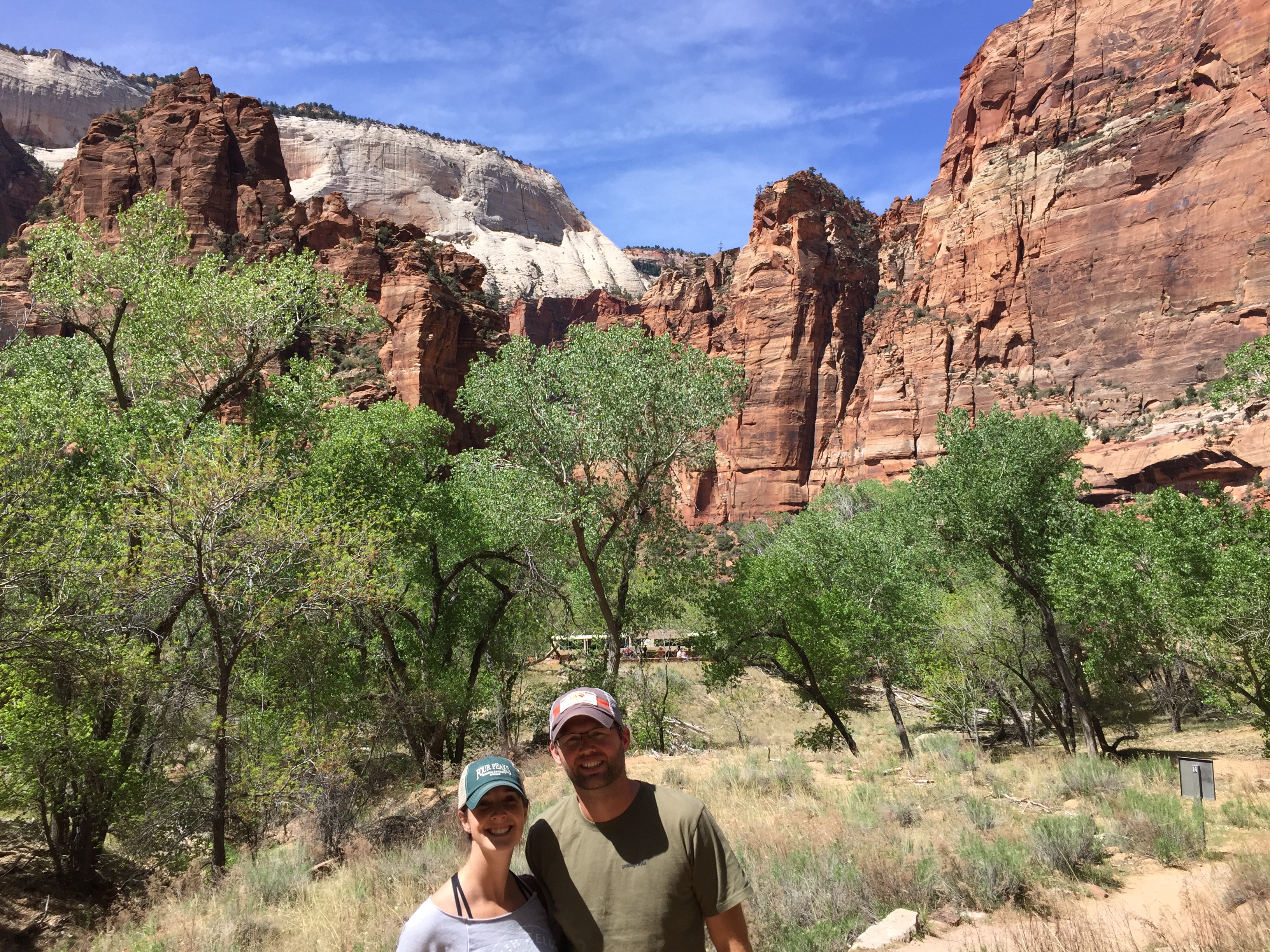
C and I left San Diego early Thursday morning and arrived in Springdale, Utah, around 2:30 p.m. We checked in at the Pioneer Lodge then went into Zion National Park for a while to do some exploring before heading to packet pick-up which was at the start line in Virgin. We didn’t hang around too long. My nerves were kicking in and I just wanted to get some dinner and get some rest. I knew the next day was going to be a long one.
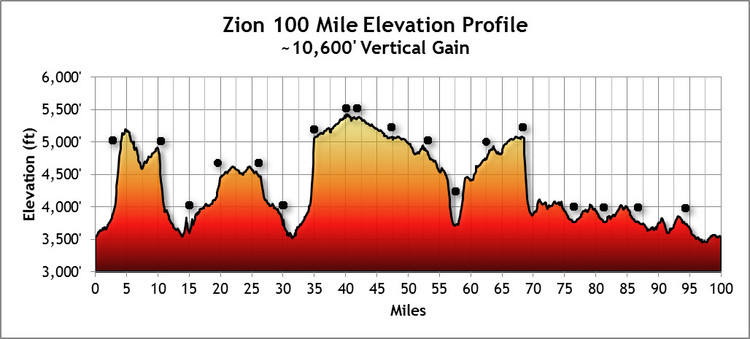
C and I in the park the day before the race.Zion 100 Course MapZion 100 Elevation Map
Race day
There’s an energy at the start of a 100-miler that’s unlike anything I’ve ever seen, and the Zion 100 was no different. Both the 100-milers and 100K runners took off at 6 a.m., and just like that it was on. My second attempt at a 100-miler was underway.
As I approached the first big climb, Flying Monkey, the sun was just beginning to rise. I got up FM with no issues, hit the aid station up top and set out on the 6-mile loop atop the mesa.
The scenery up on top of the mesa was amazing – a completely different landscape than the land below. Oh, and the views from above were jaw-dropping.
Beautiful sunrise as we were going up Flying Monkey
I descended Flying Monkey with no issues and hit a nice stretch of Jeep road and was able to run most of it, before hopping on some single track and working my way to Dalton Wash Aid (mile 15).
C was anxiously waiting for me at Dalton. She knew that by now I’d know how the day was going to go. Once I got there she asked how I was doing – my response was simply “I made it to here.” I knew if I wanted to have ANY shot of staying in this thing, I had to focus exclusively on running from aid station to aid station.
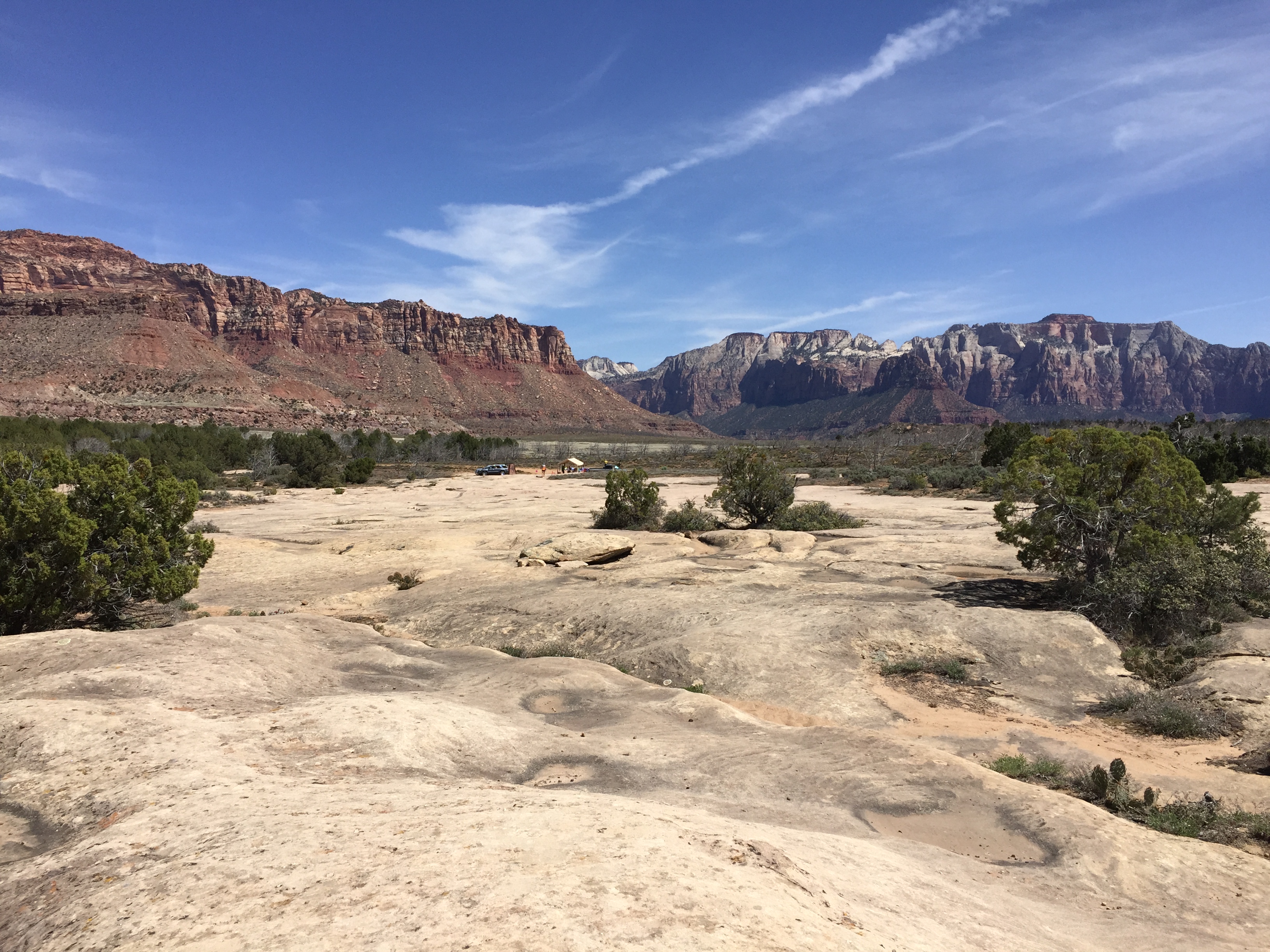
After a quick pit stop I began the climb up to the Guacamole Loop, where runners would be treated to nearly 8 miles of challenging slick rock. It was impossible for me to get a rhythm going up there, so I just enjoyed the views and tried to keep moving as best I could. I finally made it off the mesa and back down to Dalton Aid 2.
View from the Guacamole Loop.
Once I got there, I noticed my pacer and good friend Tony from San Diego had arrived and immediately jumped in to help C out in crewing me. I wanted to take a few extra minutes to rest up – my hip already wasn’t feeling great and I wanted to recharge for a minute.
Neither of them let me, and before I knew it was back on the trail.
Going up
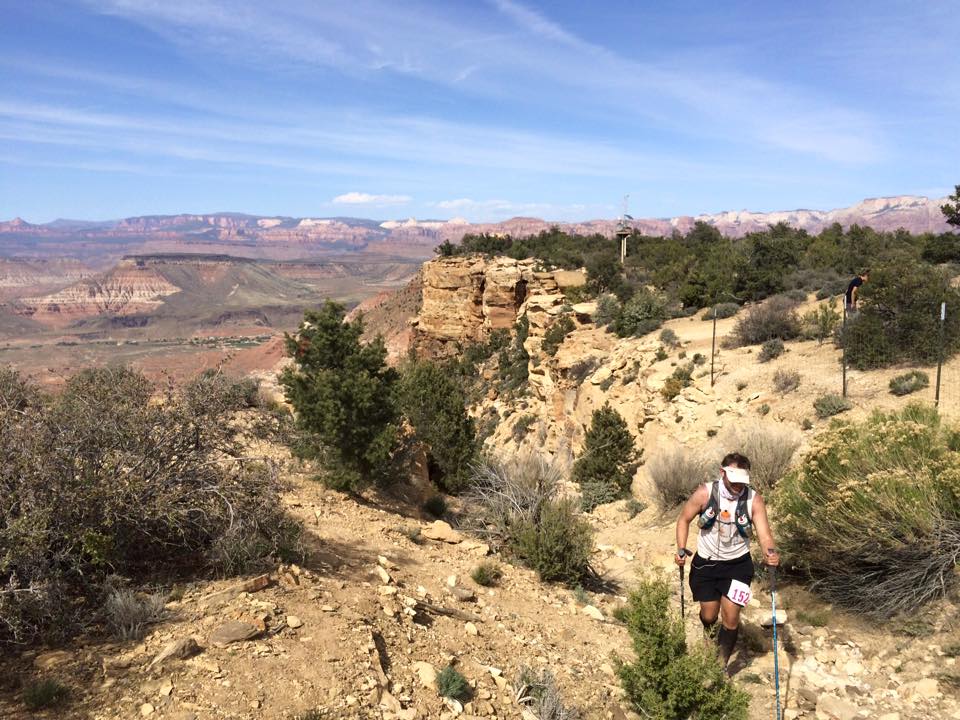
After crossing the highway I headed toward the infamous Gooseberry mesa. In my research of the race, I knew this climb was going to be a beast. The climb gains 1,500 feet. Fast. Sprinkle on some serious exposure to the sun and a subpar hip, and 1,500-foot climb felt like I was climbing Whitney.
Me coming up Goosberry. What. A. Climb.
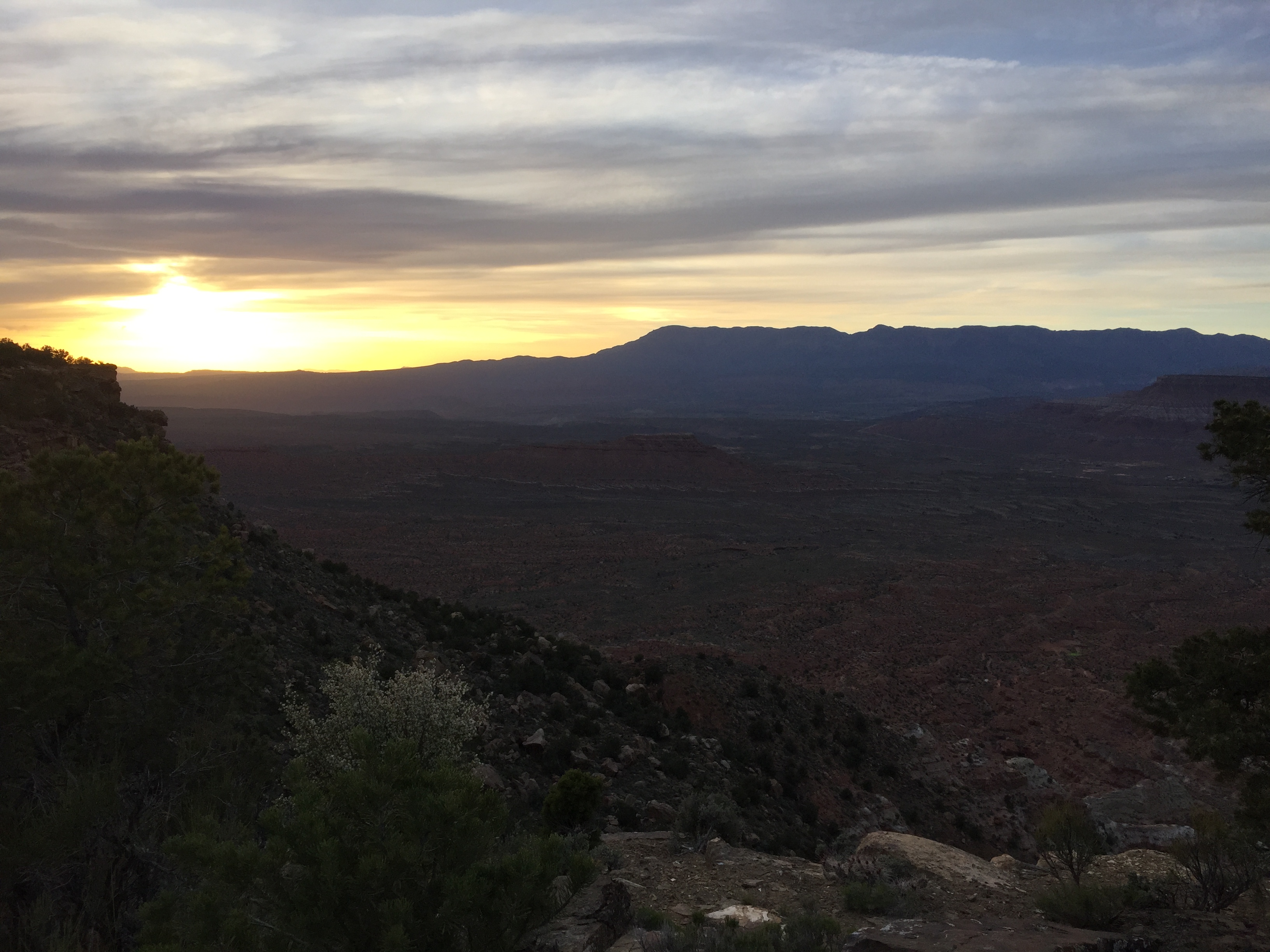
Once up to the top I came into Goosebump Aid, refueled, and then set out on my last solo loop across more slickrock to Gooseberry Point and back to Goosebump #2. I got back a little before 8 p.m., but not before taking in one of the most amazing sunsets I’d ever seen.
Unreal sunset from atop Goosberry Mesa. One of my last photos before my phone died.
By this time I was only an hour ahead of the cutoffs. Definitely not where I wanted to be. I picked up my pacer, Tony, and we headed out into the darkness toward Grafton Mesa. Running with him was a huge breath of fresh air and though we weren’t moving fast, we were still moving. We arrived at Grafton Mesa, downed some soup and headed on through. Grafton was a breaking point for a lot of runners, many of whom were still sitting around waiting to get picked up.
I’d be lying if I said the thought of dropping didn’t cross my mind. I hurt from the start, I had yet to get into a rhythm, and now I was furiously chasing cutoffs … all with 45 more miles to go.
Before I could turn that thought into any more than just that (a thought), Tony said “You ready, G? We gotta go.” And just like that, we were back on the trail and off toward Cemetery Aid Station (mile 57.5).
After a mix of single track, slick rock, climbing, and then a huge descent off the mesa, we arrived at Cemetery Aid with 45 minutes to spare. After another quick in/out we were on our way back up. The climb up was the hardest and most challenging part of the day night for me (so far), but Tony did a fantastic job of keeping me moving.
This was also about the point in the race where I DNF’d in my 100-mile attempt last year (around mile 60). Tony knew this – and though we weren’t saying much at this point, he did say this:
“You’re about to be on the other side of what you know you’re capable of. It’s all new after this.”
In a weird way, hearing that gave me a spark that I hadn’t had most of the day. It was true; I was now further into a race than I’d ever been. What a rush.
The way back was a serious grind, and making cutoffs was still a top priority (talk about a feeling of added stress!). We were in and out of Grafton Mesa #2 within 5 minutes and got back to Goosebump Aid #3 by 4:45 a.m.
By this point all I could think about was how bad I wanted off the mesa. Upon leaving Goosebump I got my wish – in the form of a 1,500-foot, pitch-black descent down Gooseberry.
I’ll leave most of the details of it, but just know that I was in a dark place (both literally and figuratively) by this point.
A change of scenery
After getting off the mesa, we had to get to the Virgin Desert Aid station by 8:30 a.m. The stretch was tough, but we got there by 7:45 a.m. My hour buffer was fading.
Fast.
Once you hit Virgin Desert Aid, the style of the race changes. Runners were now faced with a series of challenging desert loops. In prepping for this race, I had thought that if I could just “get to Virgin Aid” that I could spend some time getting re-energized before hammering the loops out, but being up against cutoffs, I didn’t have that luxury.
C was waiting for me at Virgin Aid and would be responsible for pacing me out the rest of the way (25 miles). Tony had done a phenomenal job keeping me moving overnight, knowing that I was hurting and not in a good spot. He was able to keep me on pace, and focused just on the next aid station. It was a night I never thought would end – but, like all things, it did.
For the record, Tony wasn’t unaware of what was going on at all, either. He knew we were crunched for time, had a long way to go, and that I was starting to fall apart. (He had dug deep and finished the SD 100 last year, so he knew what it took to get to the finish – and what I had yet to go through).
The red, white, and blue
By now my mental state had gotten a lot worse, and I was seriously rationalizing a second DNF in my head.
“Well G, you made it 76.5, farther than you’d ever gone – but it’s just not going to be your day. You weren’t 100% when you started … and you’re paying for it now.”
This “inner monologue” slowly started to leave my head and now C and Tony were hearing it … but they weren’t having it. They both knew me well and weren’t ready to have a repeat of last year.
And just like that, they switched roles. C was ready to go and after 5 minutes we were out on the Red Loop, a 4.7 stretch of rolling desert single track … with a cutoff of 9:15 a.m.
A snail’s pace is probably an adequate comparison to what I was churning out at this point. I asked C every 3-5 minutes “how much distance have we covered? Do you think we’ll make the cutoff?”
C, being the ever-positive person she is, assured me we were doing great and that we could make it.
I apparently thought otherwise. I began walking, saying I had “given it my best effort, but it just wasn’t going to happen.” We came in at 9:10 a.m, the cutoff was 9:15 a.m – and I didn’t think I could go back out.
I thought it was 9:15 a.m.
An aid station worker who had taken notice of me when I first came into Virgin Desert Aid came over and said “Don’t get too comfortable buddy, the cutoff is 9:30 a.m. You have to get back out there. You’ve come this far. You’ve got to keep going.”
He took my red bracelet and replaced it with a white one, to signify I was about to start the second loop.
And again, just like that, we were off.
The white loop (mile 81), was a bit longer with more rolling hills … and it was getting hot. I was kicking out salt bad and knew I was on the verge of losing control of my nutrition, but we slugged it out. All thanks to C.
It gets a bit overwhelming when you start to think that you’re within 20-30 minutes of not being able to continue on, which is exactly where we were at when we returned from the white loop.
Mile 87.1
Time in/out: 11:10a.m./11:22 a.m.
Cutoff: 11:30 a.m
The same aid station worker that had kept me on course earlier found me again and offered me more words of encouragement and advice. His support, along with C and Tony’s was hitting me hard, but I was falling apart. I hadn’t stopped for more than 5-10 minutes since mile 47.5. My hip was on fire, my feet were all blistered, and my nutrition was in the tank. I was a mess.
Even with all the support I was ready for a DNF in my head. But my crew didn’t let me act on that thought and sent me back out. I had more than 3 hours to go 7 or so miles. But like I said, I had fallen apart. I was walking/shuffling along at a dismal pace, and things were looking bleak.
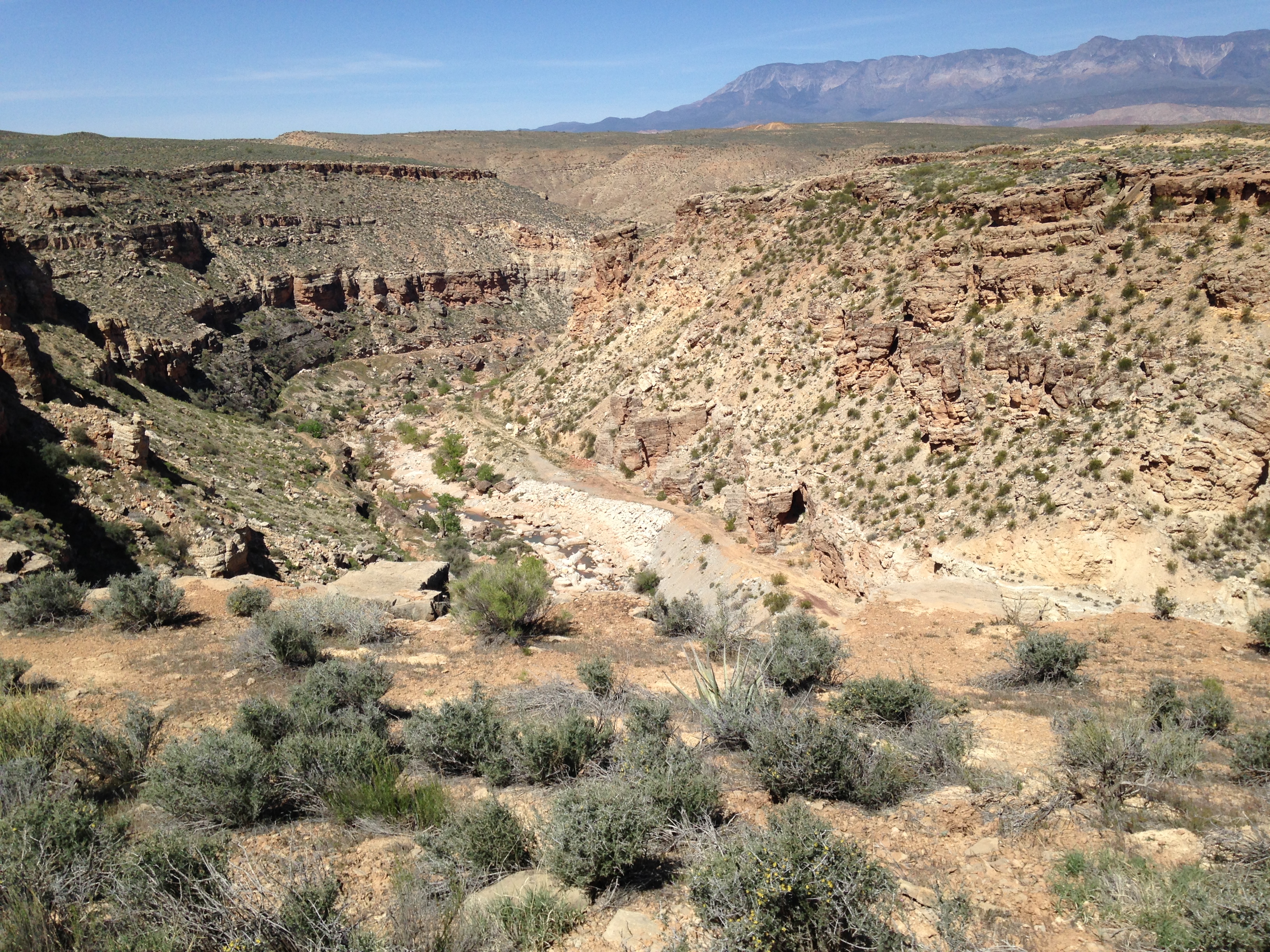
The blue loop was also the most exposed (and challenging) of the loops, and the sun was just roasting us. We had caught up with a few other people who were in the same boat, wished them well and continued to shuffle along.
A view from the blue loop
C did an unreal job pacing me, knowing just when to talk and when to let it ride. When to let me vent and when to tell me to man-up. It was a delicate balance and she managed it well.
In my head I thought that IF I could somehow get back to Virgin Aid for the last time by 1:30 p.m. that would give me 2.5 hours to finish, and at the pace I was moving at, I thought I MIGHT have a shot.
But 1:30 p.m. quickly passed, and I was still out there. I watched 1:45 and 2 p.m. tick by as well, before getting returning to Virgin Aid for the last time at 2:18 p.m.
Mile 94.
That was it. I came into that aid station to drop. I was dehydrated and distraught. I thought I had left it all out there and came up short. There was no way I could go 6 miles in less than 1 hour 45 minutes based on how I had been performing for the last 12 hours.
It wasn’t possible. Not to me.
I walked in and sat down, ready to make my announcement, but before I could, the aid station volunteer dumped an entire cooler of ice water over my head, and said “Hey buddy, you look like hell, I know you feel like hell – but YOU. CAN’T. STOP. YOU GO FINISH THIS THING! YOU’VE COME TOO FAR TO QUIT!”
His statement was matched with Tony handing me two new water bottles and C pulling me back out on the course.
This was it. We were going for it.
The ice bath was reinvigorating – and the support from my crew and the aid station worker helped stoke a fire deep within me. I was 94 miles in. I had 1 hour 35 minutes to give it everything I had.
And so I did.
For the first time since miles 10-20 I started running. As hard as I could. I’d tell C to “Go” and we’d run as hard as we could, walk and repeat. Tony had parked near mile 97 and was stressed to the max, he knew I had fallen apart and my pace was bad.
Until he saw C and I come around the corner. 3 miles down in 35 minutes. Some of the fastest miles of the day for me were miles 94-96. I had 3 miles to go – and more than an hour to get there.
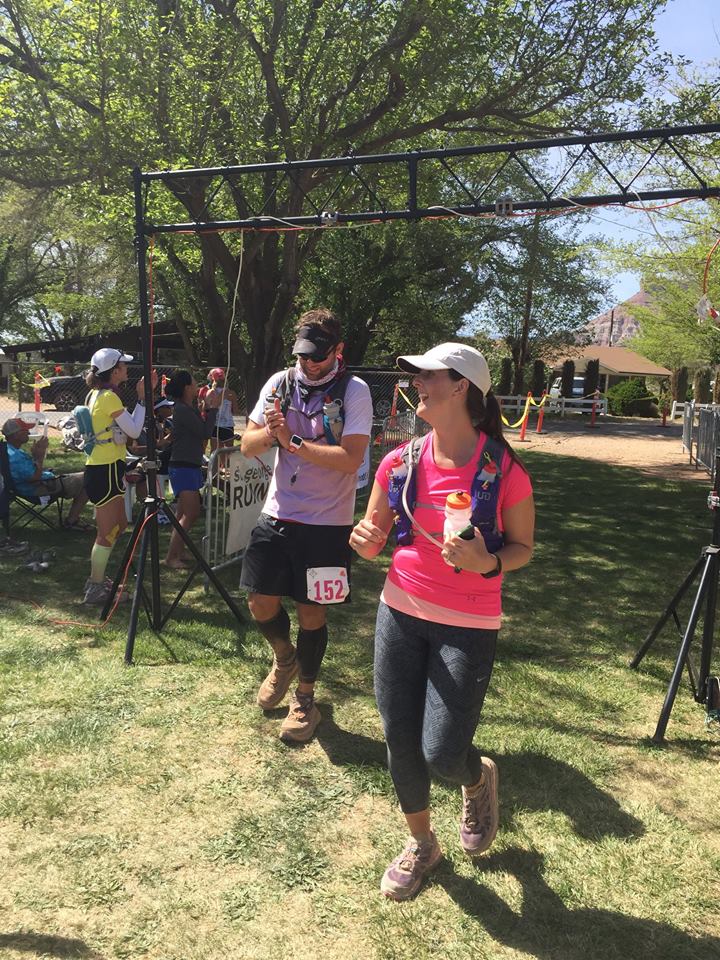
I gave the next few miles all I had as well, and came across the finish line in 33:25, side by side with C, Tony, and my friend Corina, who had hung around to watch me finish.
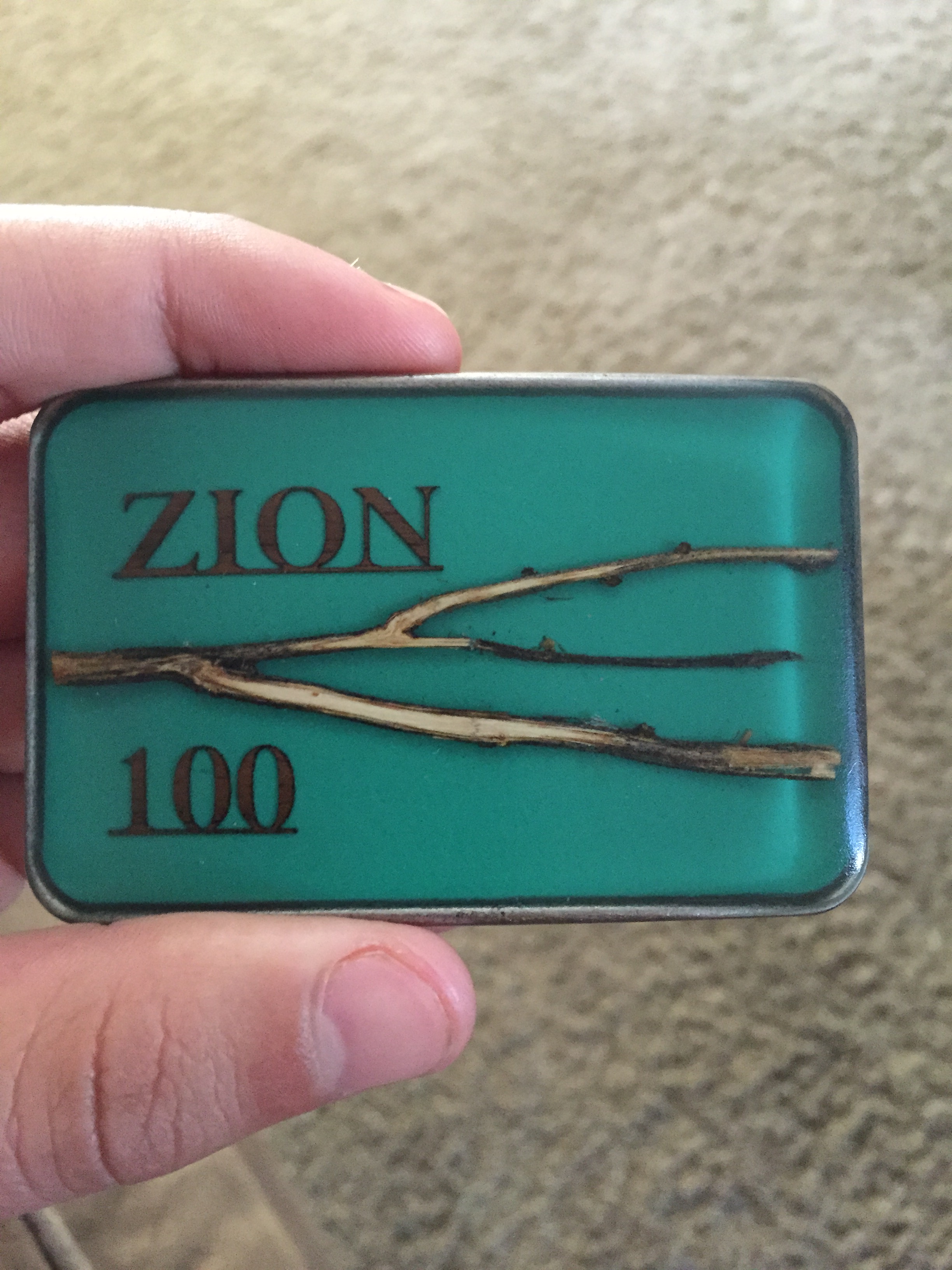
Finishing my first 100-milerHandcrafted buckles were awarded to all finishers. After two years, I finally got mine.
I couldn’t have done it without the support of C, Tony, Corina, the aid station worker, and my fellow runners. It truly was a life-changing experience. I learned more about myself during this race than I ever thought possible, but most importantly, I learned to never give up – in running or in life.
The gang at the finish. I wouldn’t have finished without them.
It’s hard to believe it’s been two weeks since C and I road tripped to northeast Arizona for the Monument Valley 50. The weekend was amazing, and not just because of the race. In fact, even though we logged 24 hours in the car on a trip that lasted less than 60 hours total, we both agreed that we’d do it again in a heartbeat.
We took off from San Diego bright and early, at 3:30 a.m., and hit the road. This was total déjà vu for me, having done a similar middle-off-the-night departure to get to the Antelope Canyon 55K just a few weeks prior. But lucky for me this time I’d have company, both in the car and on the trails, as C was coming along to pace me for the last 15 miles of the race as training for her pacing duties at Zion.
As much as I enjoy road tripping alone, having C along for the ride was a complete blast. We made great time and were through Phoenix before either of us knew it. From there, we were northbound for a few hours, before heading through Flagstaff and on to Monument Valley.
We lucked out and snagged a last-minute cancellation at a hotel called The View just a few hundred feet from the race start/finish line. After checking in and dropping off our bags, we decided to make the most of the daylight we had left.
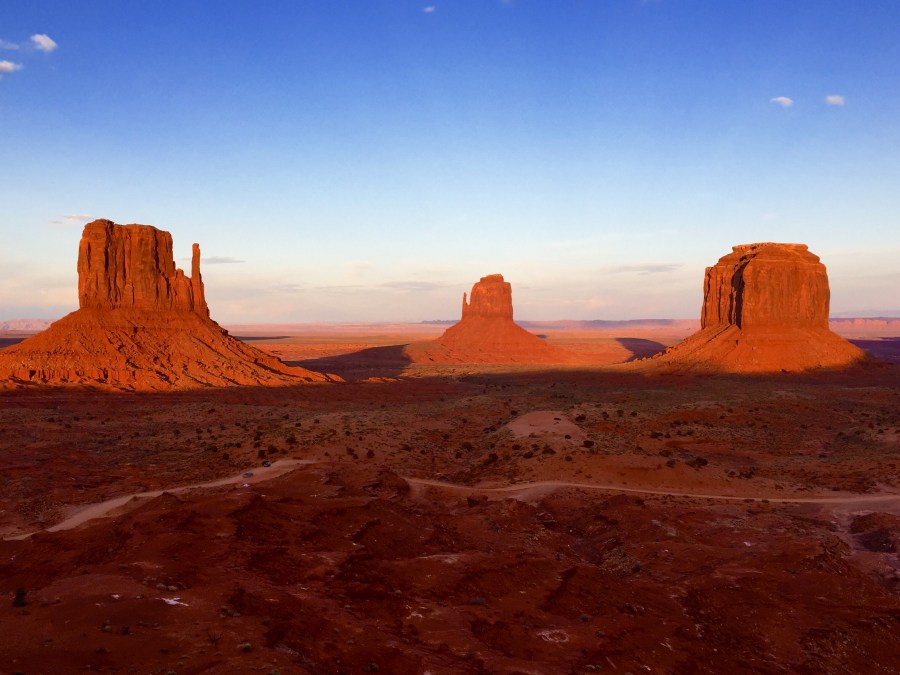
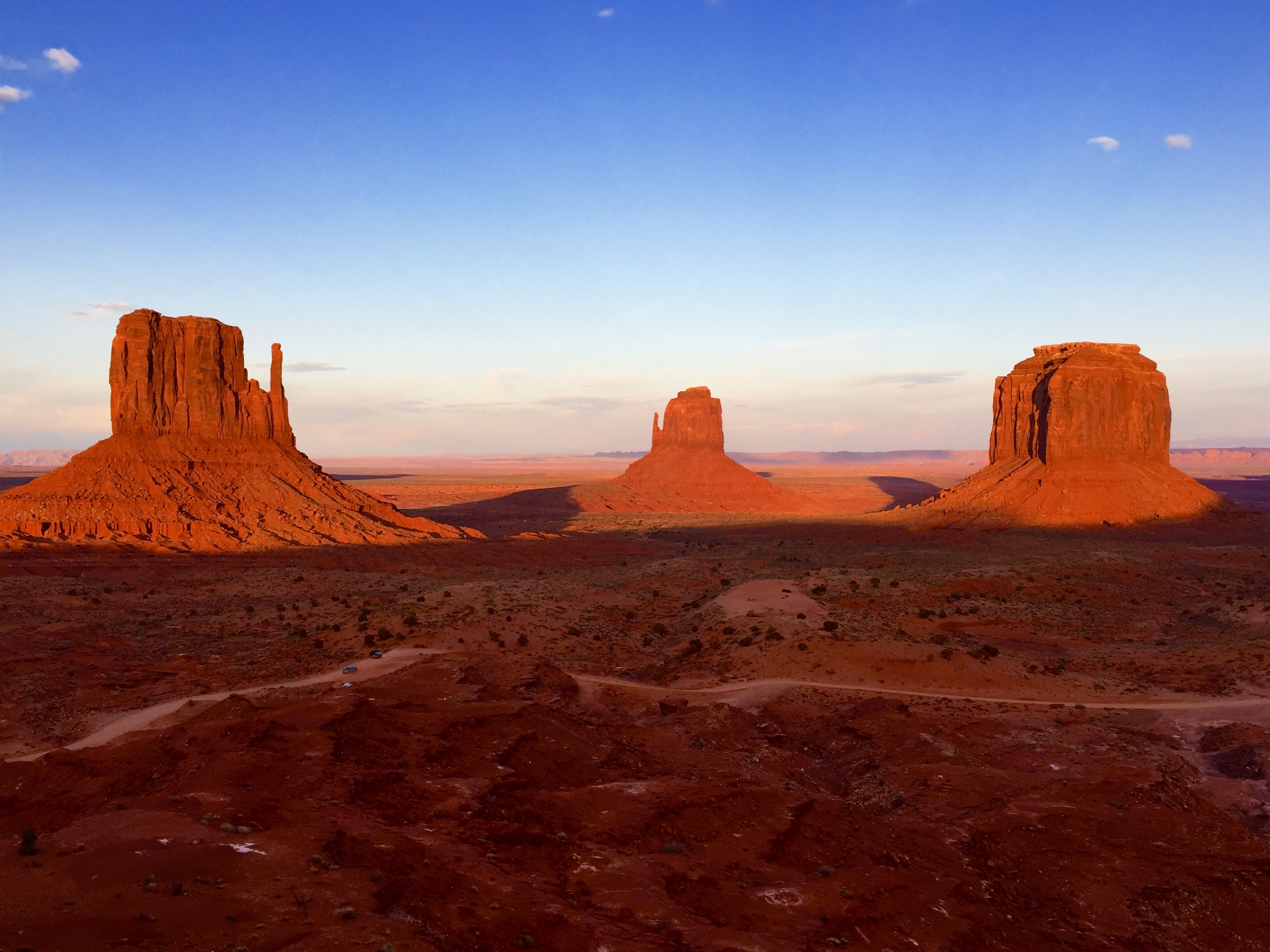
Monument Valley as the sun set the night before the race.“Well, I’m pretty tired. I think I’ll go home now.” Just kidding! I’ve got the Monument Valley 50-miler tomorrow!
After a nice meal at the hotel and an evening walk to take in the scenery and look at the stars, it was off to bed (except for when we got up and to look at the stars again at 3 a.m.).
Race Day
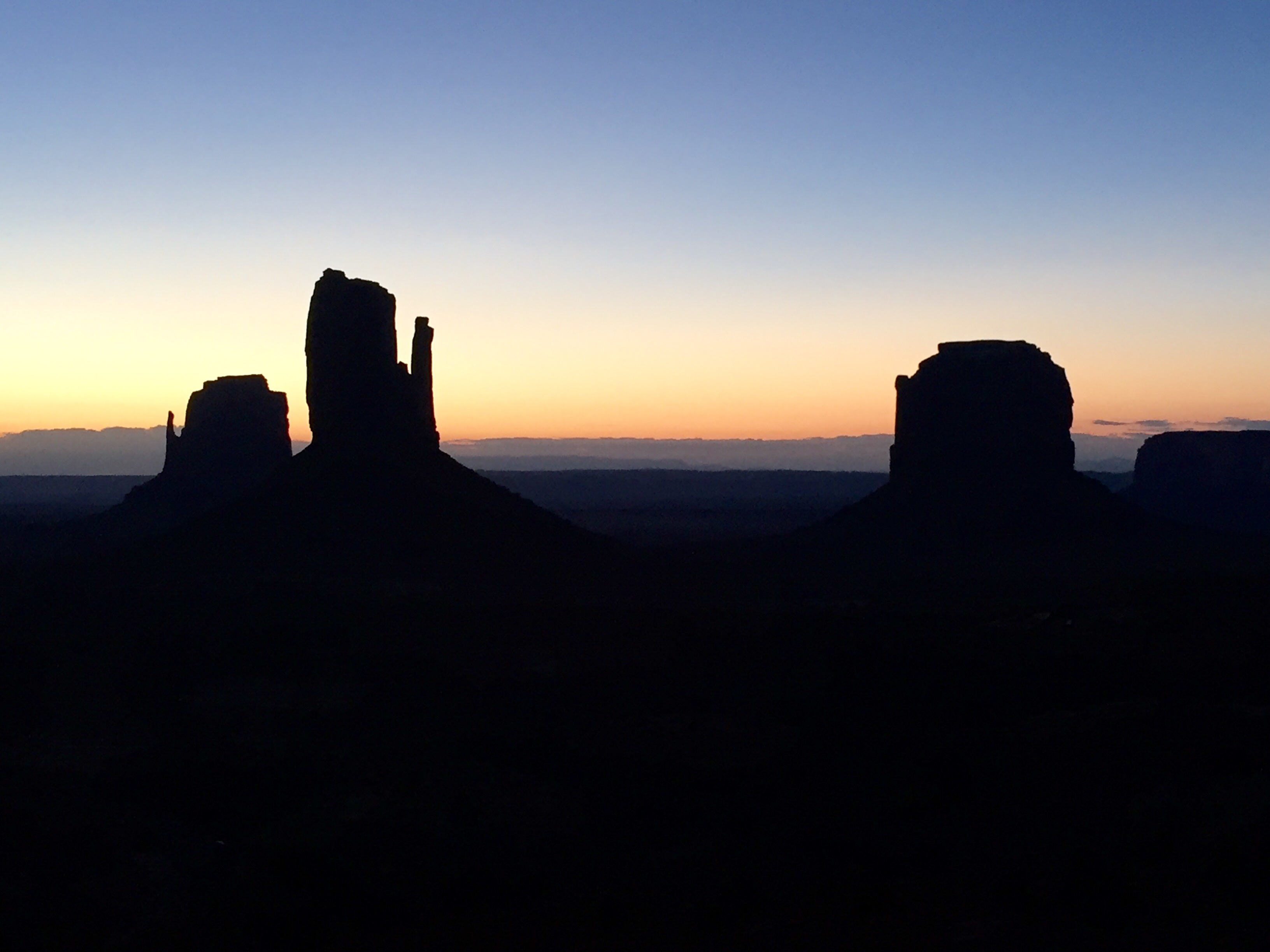
Monument Valley 50-Mile Race Elevation ProfileMonument Valley 50-Mile Course MapSun rise at the start line
Prior to the 50M/50K start, runners were treated to a Navajo Prayer Ceremony at the start line and then, promptly at 7 a.m., were off on our way.
I thought that Running Antelope Canyon a few weeks prior had given me a pretty good idea of what to expect, but since the Monument Valley area had been hit by extreme weather during the past two weeks, I knew it was best to take anything I thought I knew about the course conditions, throw it out the window, and prepare for a long, tough, sandy day through the Navajo Nation.
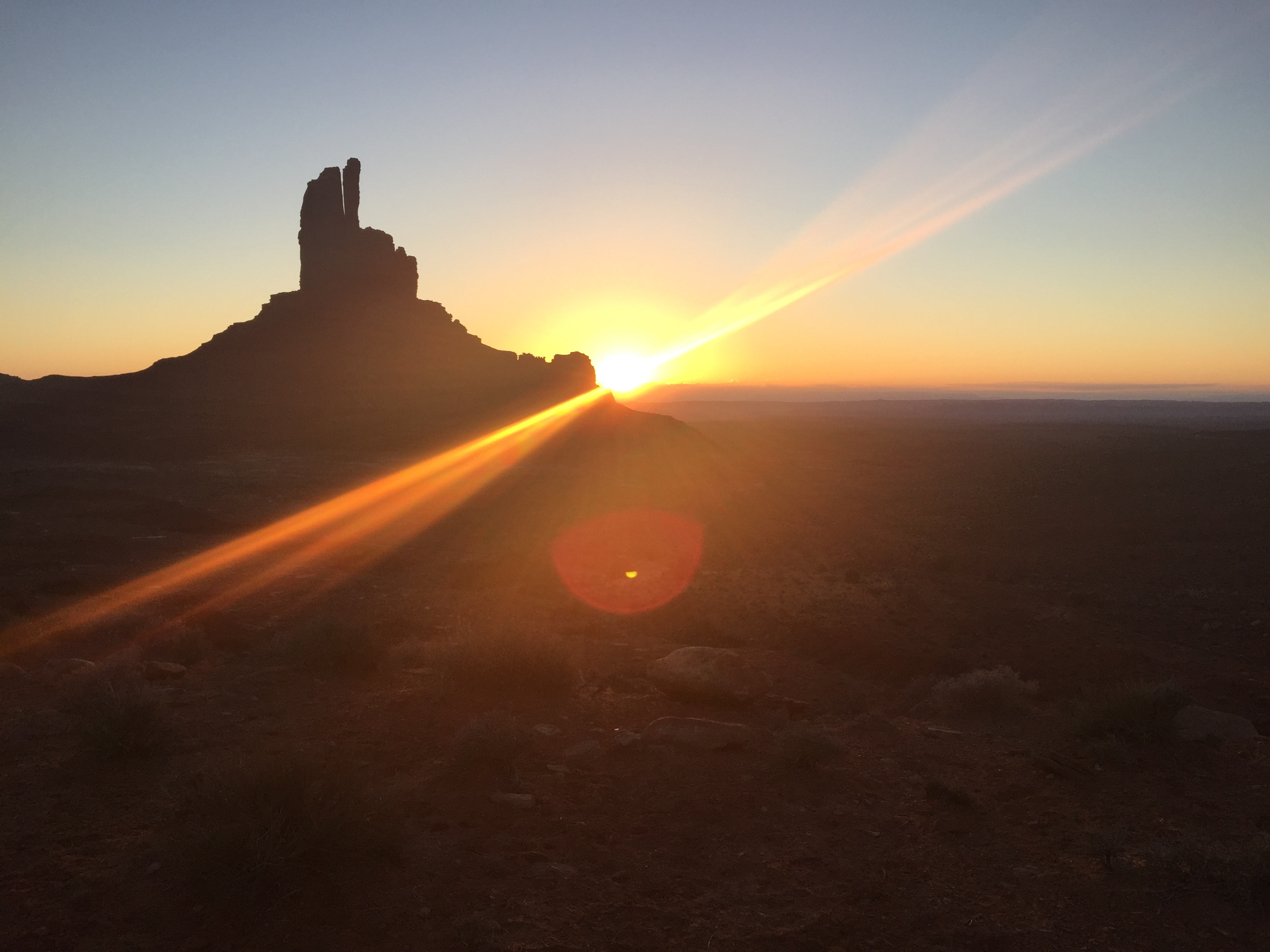
Sunrise somewhere near Mile 4
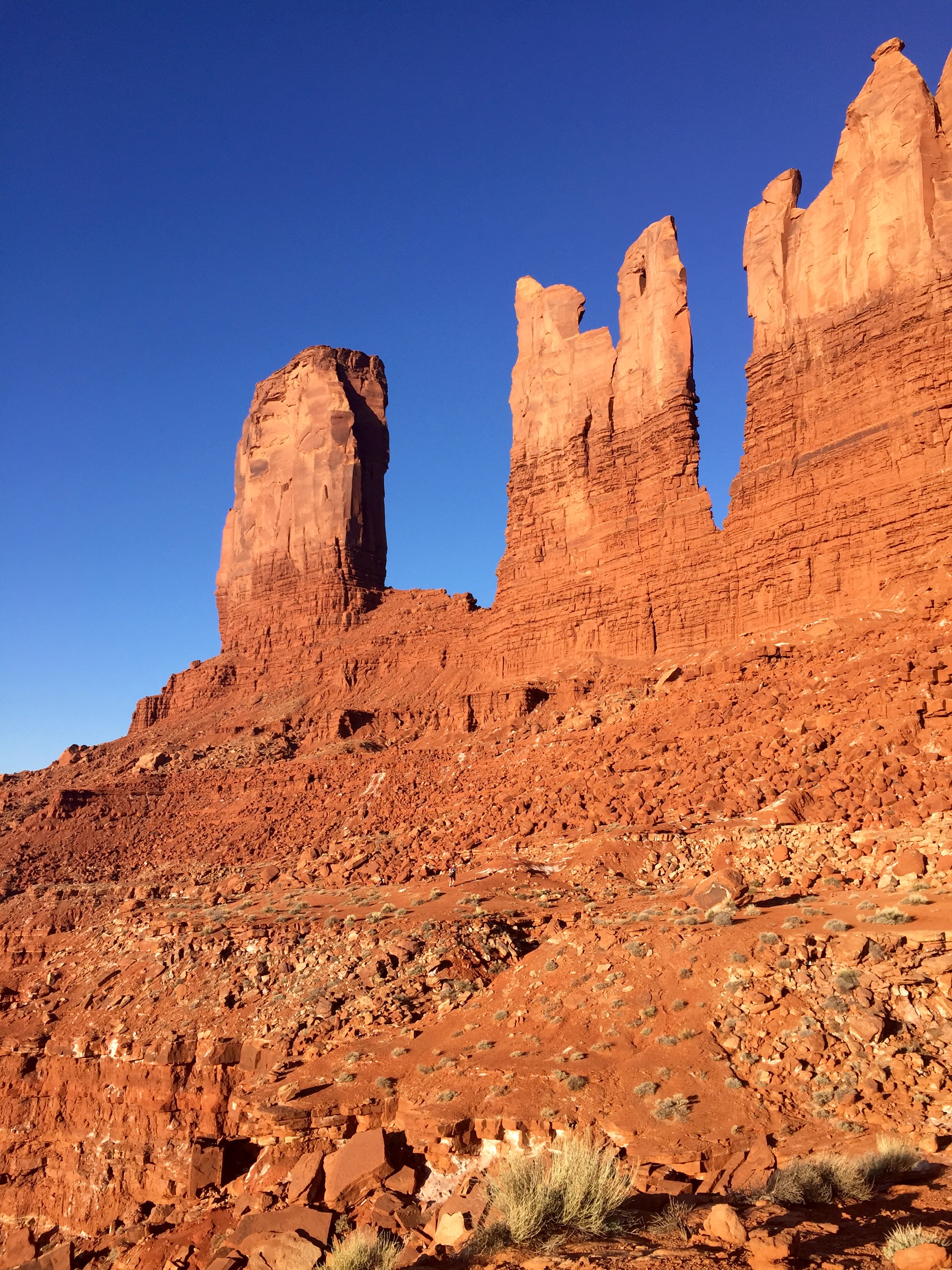
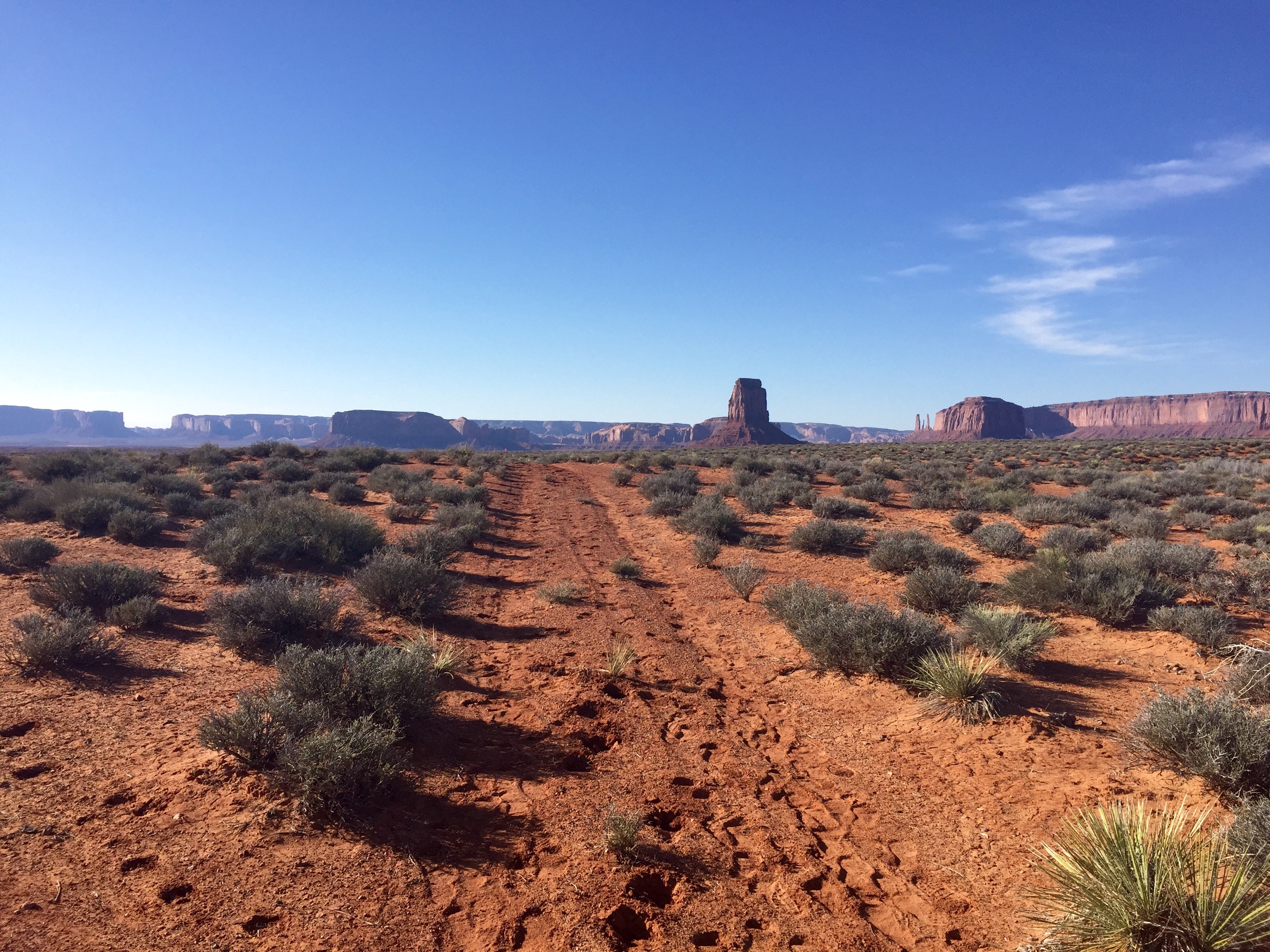
With less than 60, 50-mile runners, the pack thinned out fast, and runners were able to experience the area’s beauty on their own. As I trudged along through the sand, it quickly became apparent that I was going to get, way, WAY closer to the monuments than I had originally thought. By mile 9, I knew this was going to be one of my favorite races to date.
Near Brigham’s TombSandy conditions for miles
The weather that hit the area earlier had helped “pack down” some of the sand, but most of the miles between Brigham’s Tomb Aid (mile 9) and Hogan Aid (mile 22) were still a challenge. I hit Hogan’s Aid for the first time in around 5 hours, feeling pretty good overall.
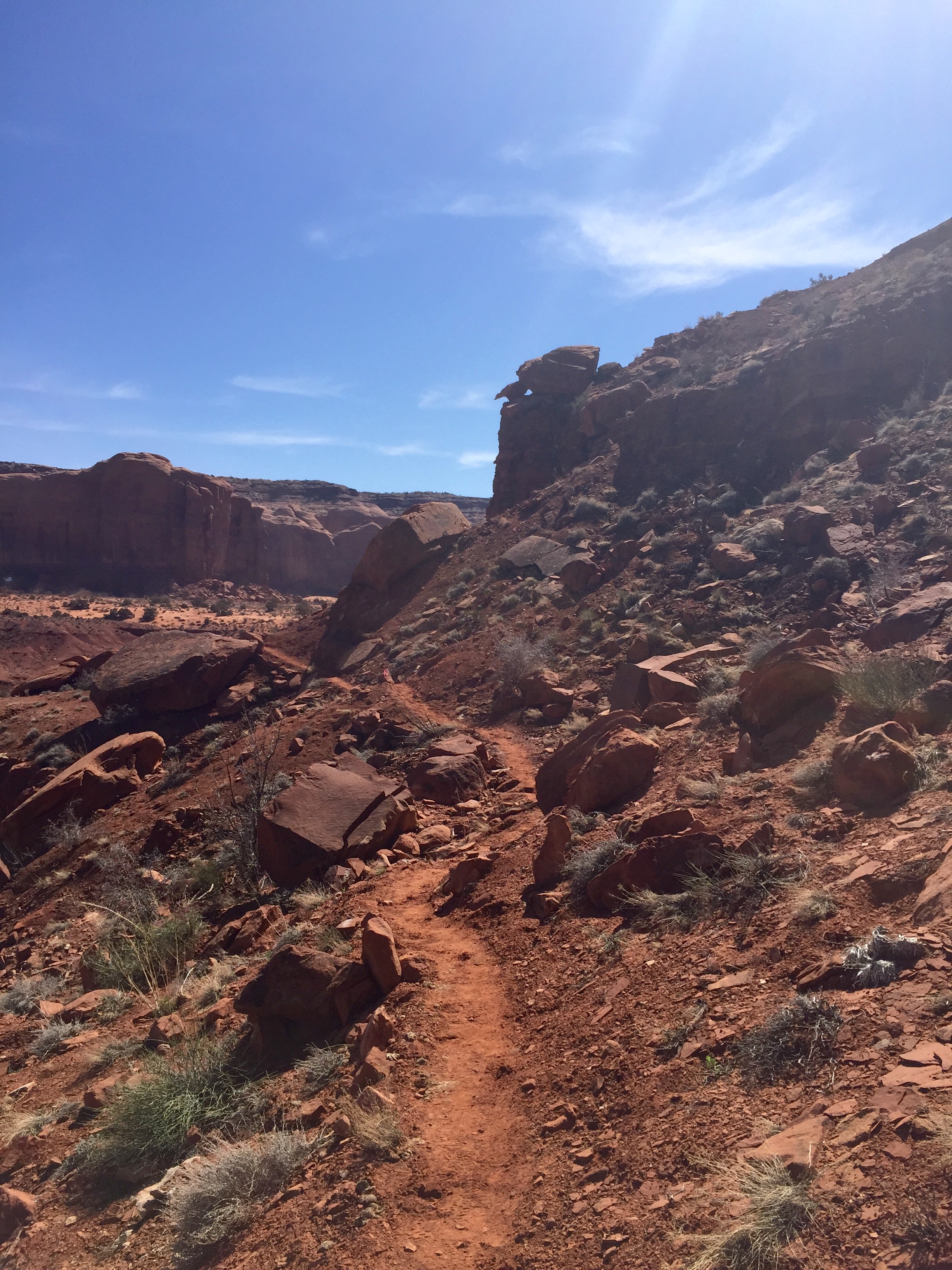
From Hogan, the 50-milers would do a series of loops, all of which passed back through Hogan before heading onto the next. The first loop (North Windows) took runners out on some of my favorite singletrack of the day. The views were simply unbelievable.
Running beneath the monument
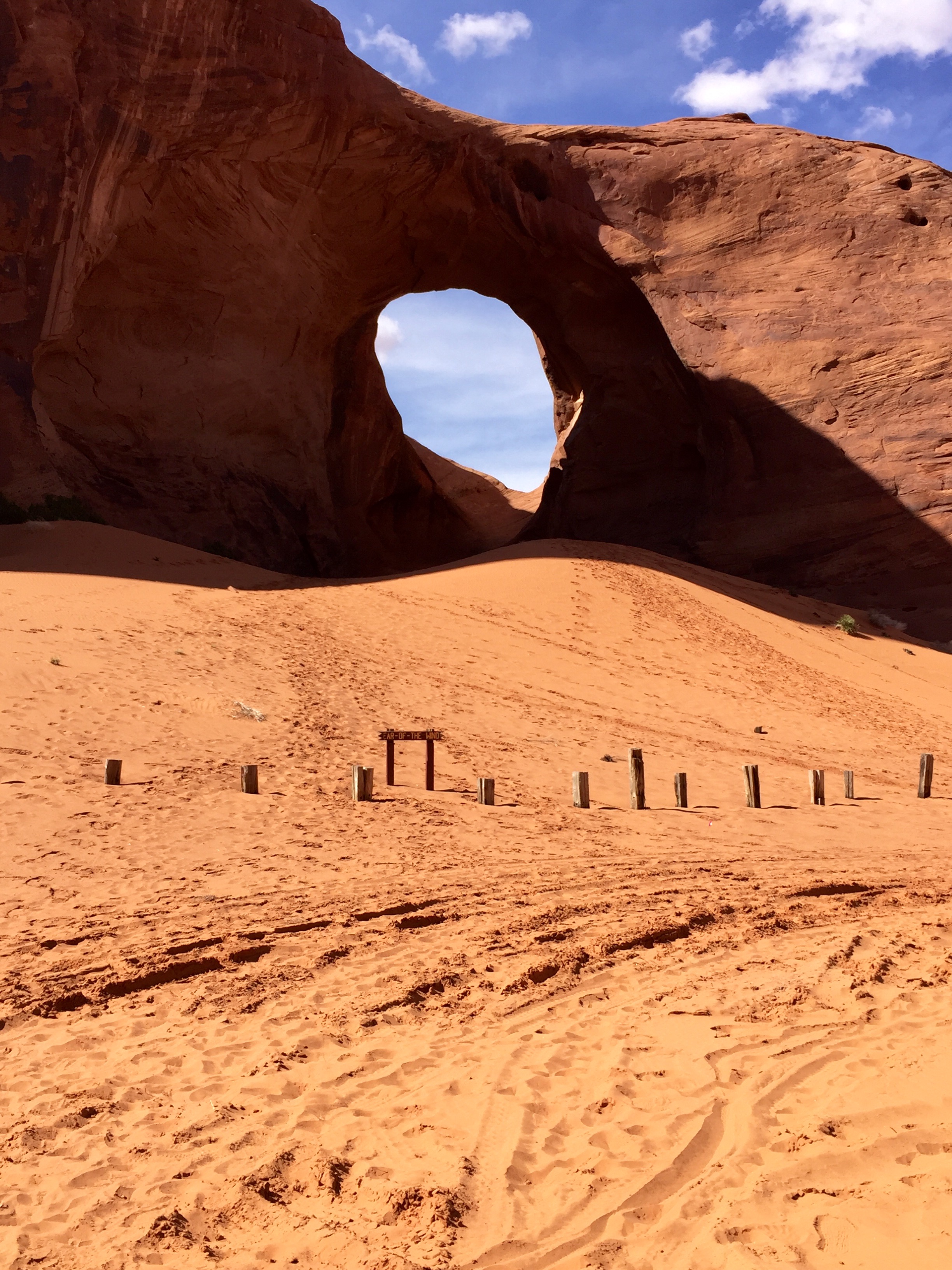
After North Windows, I cruised came through Hogan before heading out on the Arches Loop. This 9.5 mile loop was incredible … and sandy. But mostly incredible.
Is this the Sahara? No, it’s Monument Valley.Ear of the Wind
I returned to Hogan for the final time at 3 p.m. and picked up C, who was planning to run the final 15 miles with me. We headed off to Mitchell Mesa – which would be the biggest climb of the day at mile 40.
(Sidenote: To the group of volunteers at Hogan Aid, kudos on running such a great aid station. With runners hitting this aid station multiple times, I estimate they saw somewhere between 800-1,000 runners. Every time I came through food and support was plentiful and spirits were high. One of the best aid stations I’ve ever ran through. Thanks again – you all were great!)
Heading up Mitchell Mesa was tough. The trail up was really technical and slow going, but once we got to the top, the views we got where the highlight of my day. Words don’t even do it justice.
The view from the top of Mitchell Mesa
At the same time I was up there, I noticed a local Navajo man up there … ON HIS HORSE. I couldn’t help but stop and ask how he got up there with that horse. He smiled and simply said “the same way you two did.”
We weren’t the only ones on top of Mitchell Mesa …
I had a lot of interactions with the local Navajo throughout the day, each of which was an incredibly memorable (and positive) experience. Talking with them about their land, its beauty, and its history was a once in a lifetime experience that we all enjoyed.
Coming down Mitchell Mesa was a lot more fun than going up, and before I knew it C and I were back to Hogan Aid for the final time. Just 3.2 miles were left until the finish. I’d been out there a little more than 12 hours and was feeling pretty thrashed … yet I couldn’t wipe the grin off my face.
Having C out there as my pacer was fantastic. She did a great job keeping me moving and helping me forget about the pain. Definitely a natural!
Together, we knocked out the final 3 miles and crossed the finish line at 12:53:36 (30/41).
50-mile race finishers received a bracelet handcrafted by a local Navajo family
The next morning, bright and early, we put about 700 more miles on my Altima before arriving back home in San Diego. Talk about a whirlwind trip!
One that neither of us would change for the world.












 Life Through the Miles