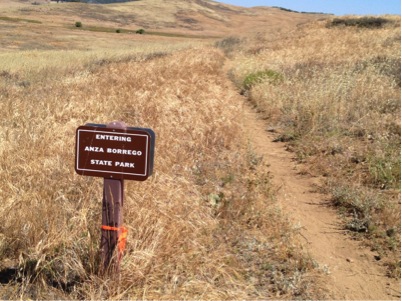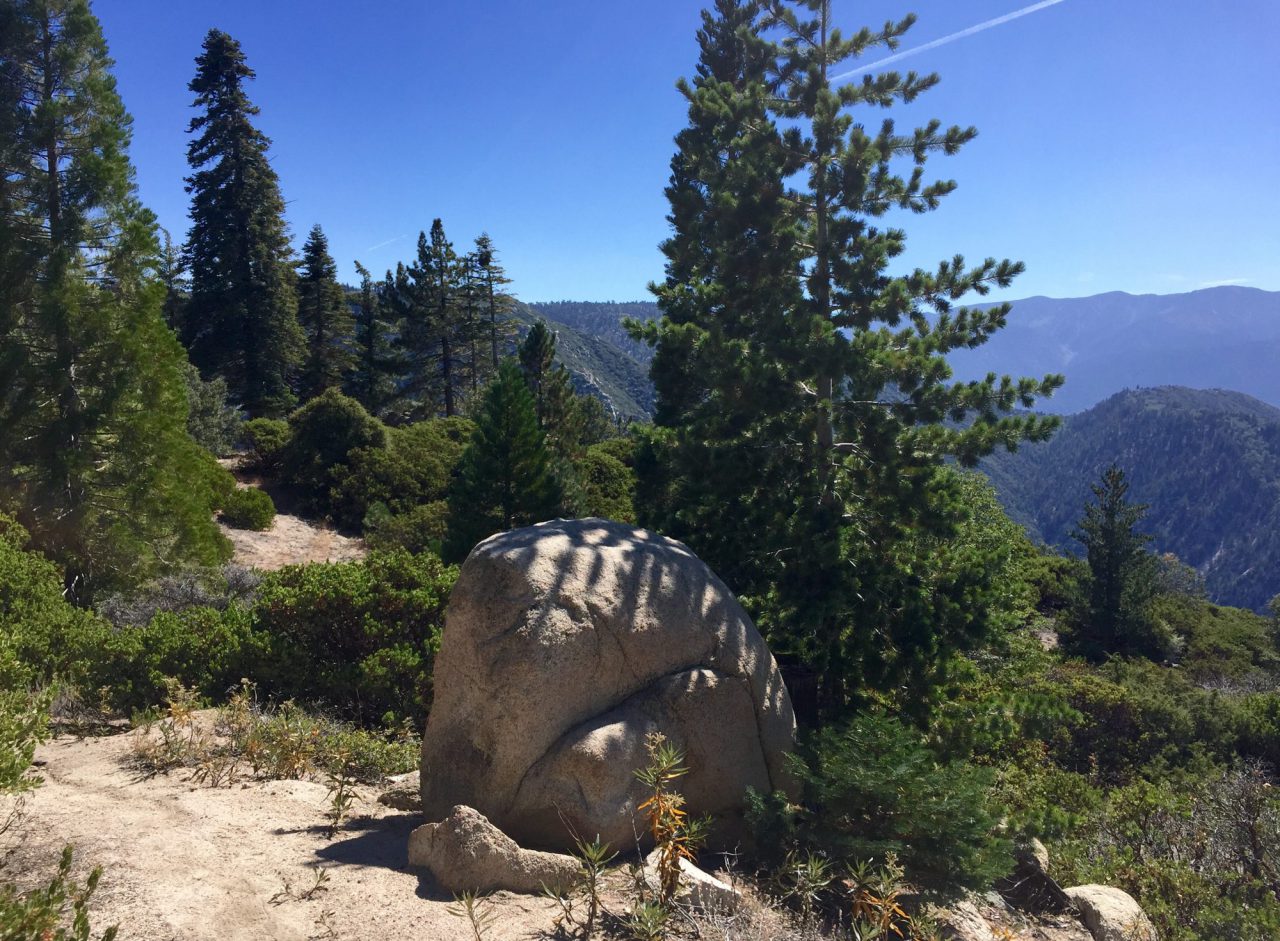
Lost Boys 50

Blown Away: The Lost Boys 50 Mile Ultramarathon

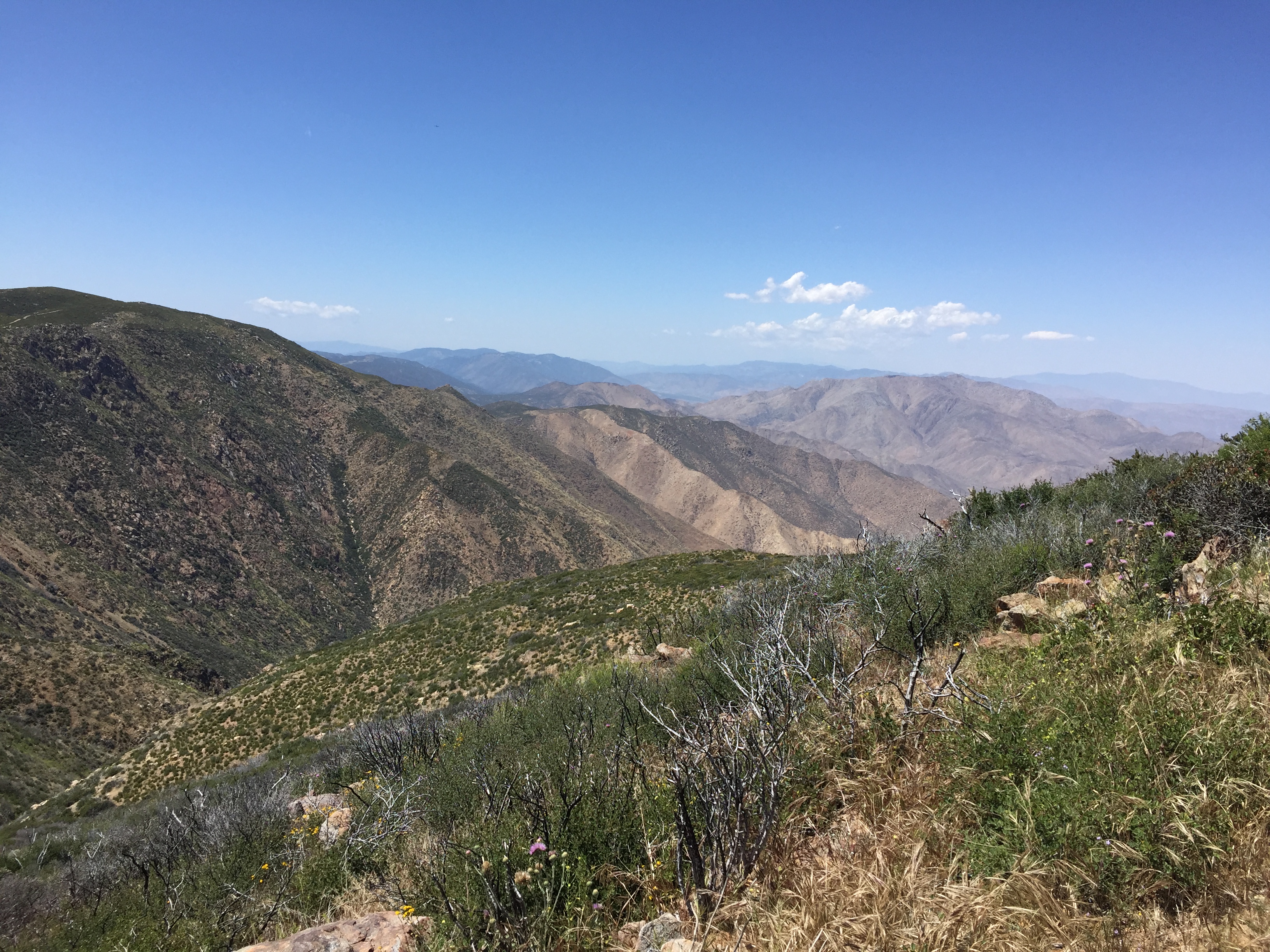
“There is something primitive about running from the desert to the mountains.” – Ben Hian, Lost Boys 50 course record holder.

 Ever since I moved to San Diego and started running ultras, I wanted to run the Lost Boys 50. I had heard so much about this race and its long, checkered history that I knew I had to experience it for myself. Last weekend, I got that chance.

C and I—and my parents—arrived in Julian the Friday before the race. My parents had flown out from Iowa to see me run, so I was extra excited about that. We had a great dinner at Romano’s before retiring to our cabin for the night (Note: If you’re running a race in the Anza Borrego/Cuyamaca/Mt. Laguna area and want a good Italian, pre-race meal, this is the place).

We were up early since I had to be at Lake Cuyamaca to catch the 3:30 a.m. shuttle down to the desert. Once on the bus and heading down I began to hope the weather would hold up for what was sure to be an epic race day.

As the runners piled out of the shuttle, we quickly realized we were going to be in for a windy, WINDY day. But it wasn’t raining, so we had that going for us.

After checking in and hiding from the wind back on the buses, it was time to go. Runners huddled around Race Director Brian Gonzales to get a quick history lesson on the race before heading out into the still-dark desert. Just like that, we were off.
Lost Boys 50

Pinyon Wash to Blair Valley (0 – 17.9)

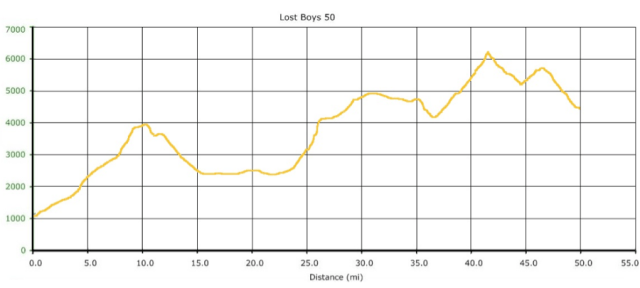
The race wasted no time accumulating the 9K of elevation gain runners were promised, with the first 10 miles of the course gaining almost 3K. I ran into my friend Carlos, and we took it easy together the first 5 miles, catching up on life and things since we hadn’t seen each other in awhile.
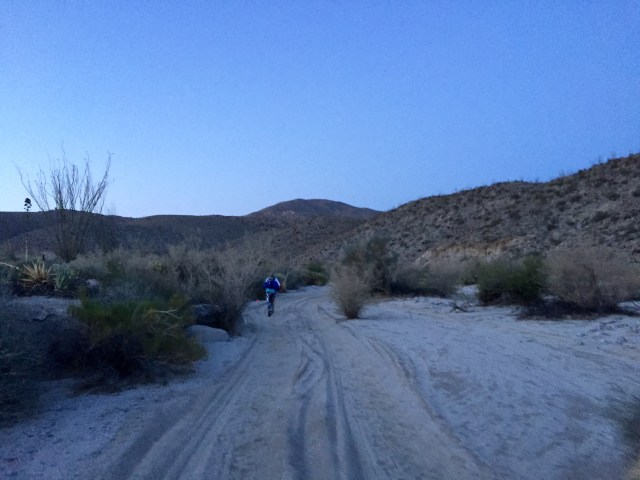
Lost Boys 50

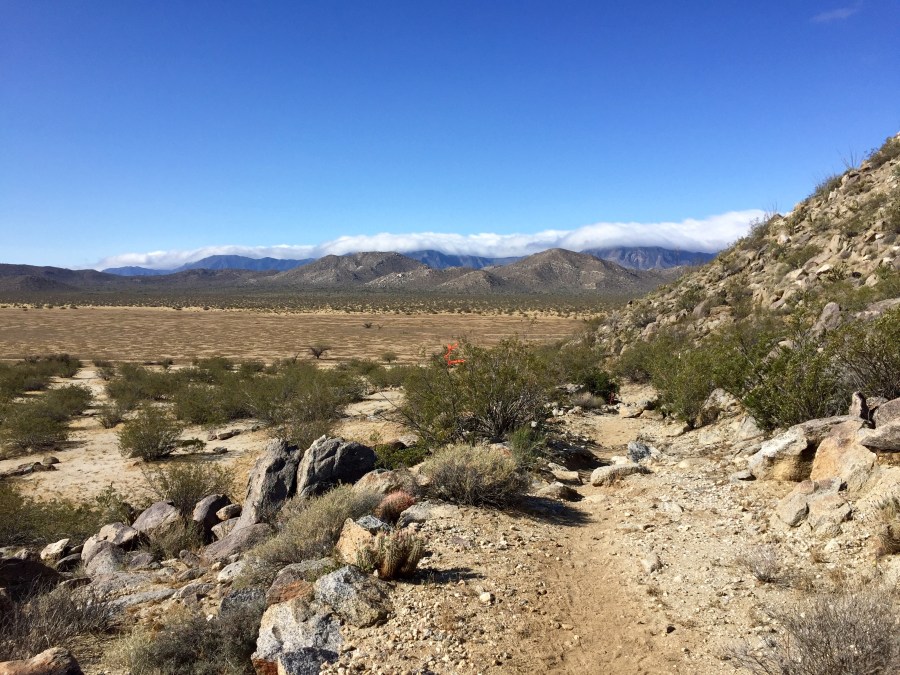
After hitting Boulders Aid (5.1), Carlos took off and I settled in for the day. I was really excited about the first 20 miles of the course, since I’d never ran in that area before. The miles didn’t disappoint. Runners ran through desert canyons, scurried over boulders, came across abandoned mines, and more. It was amazing.
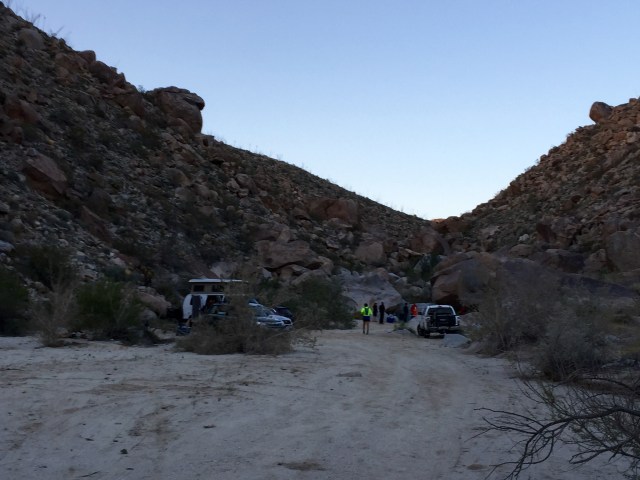
Lost Boys 50

I hit Pinyon Mountain Valley Aid (12.4) right on time. I was in/out of the aid station in less than 3 minutes and was off toward Blair Valley, the first place I’d be able to see C and my parents. The next few miles were a slow steady decline where I just zoned out, enjoyed the desert views and began thinking about how I wanted to tackle Oriflamme Canyon.
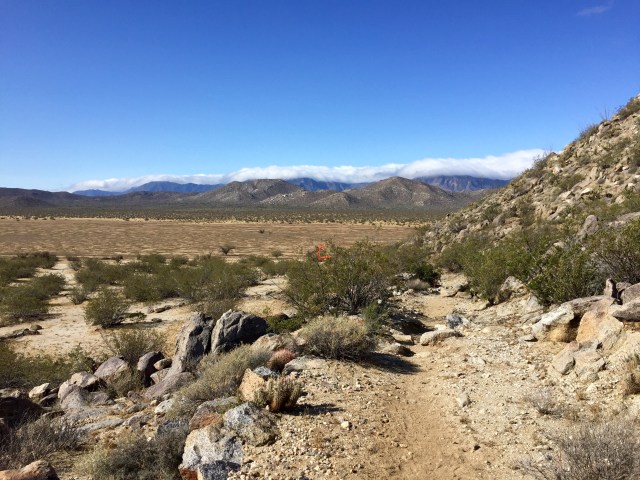
Lost Boys 50

Blair Valley to Pedro Fages (17.9 – 29.4)

I got into Blair Valley Aid at about 9:15 a.m., and was met immediately by C and my parents. I could tell my parents were getting into crewing and were having a great time already. I was so glad they were getting the opportunity to experience the sport I love first hand. After refueling, and chatting with them a bit I was off.

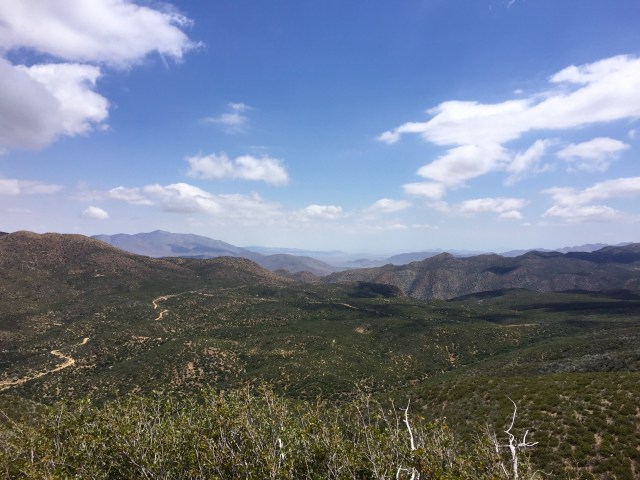
Before I knew it I was back at the mouth of Oriflamme Canyon. It had been a few years since I’d ran through the canyon, but I still knew it was going to be brutal. I settled into low gear and started the long grind to the top. On the way up I reflected on just how far I’ve come in my training in only a few short years.
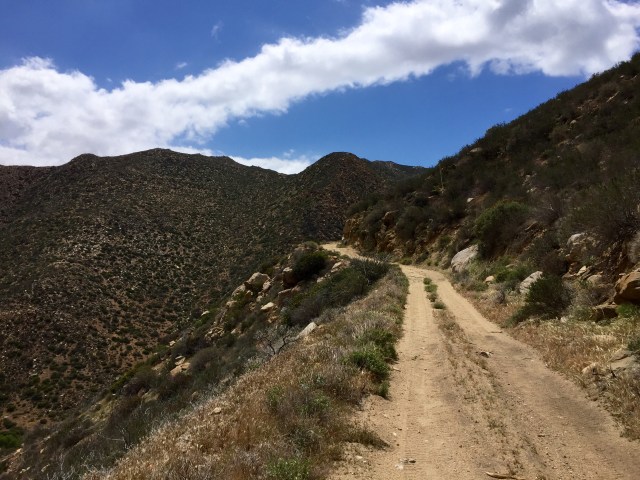
Lost Boys 50

Lost Boys 50

I got out of the canyon with no major issues and after a short run across the meadow, I arrived at Pedro Fages, right on schedule.

Pedro Fages to Cuyamaca Lake (29.4 – 50ish)

Though I was on my goal time, I was tired. The constant battling of the wind and slow steady climbing was really taking it out of me. I took some time to reload my pack, refuel on soup, and get rejuvenated by wiping myself down with a Pro Energy Towel. A few minutes later, I was out and heading toward West Mesa aid station feeling great.

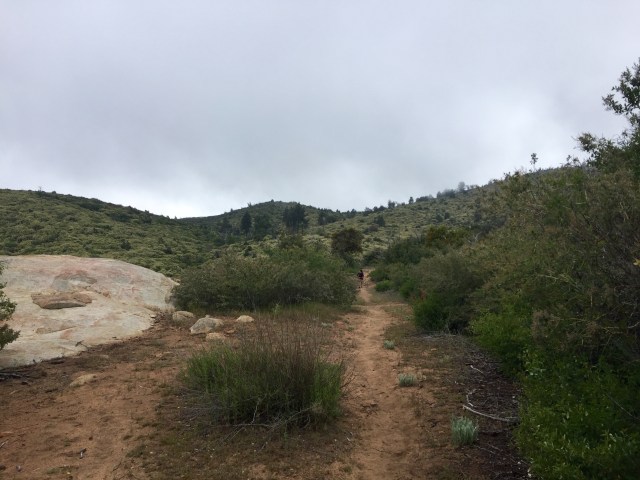
The forecast had called for rain and we’d been lucky enough to dodge it all day … but one look at the sky and I knew it was only a matter of time, so I picked it up a bit.
Lost Boys 50

By the time I got to West Mesa aid (36.1) I was actually ahead of my goal time. There was one climb left, the climb up to Cuyamaca Peak. I wasted no time getting started.

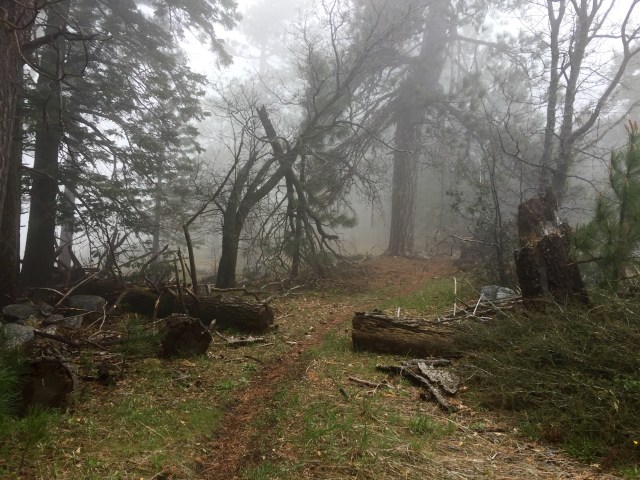
I was pretty wiped out by this point. The more I ascended, the more I was climbing up and into a foggy/cloudy oblivion. By this point runners were very spread out, so at times it almost felt like you were in a dream … or a horror movie.
Pic 7

Regardless, I was in the zone and cruising. Apparently cruising a bit too well, as I blew right by a very well-marked junction and ended up off course for awhile. It was a minor mental blow, but I couldn’t help but laugh when I retraced my steps back to the junction. It was so well marked!

I finally got to Cuyamaca Peak aid station (42.9) dropped my pack, grabbed a grilled cheese and cup of soup and started the short out-and-back climb to the peak, before looping back through CP aid, grabbing my pack, and beginning my descent.

As I started my descent I was mentally prepared to just run it down and into Cuyamaca Lake, but as I started coming down I replayed what one of the aid station volunteers at CP aid had said “you have mostly down left, than just a little up before you get to the finish.”

Immediately it hit me; we’re going up over Middle Peak!

Damn.

The same thing happened in last year’s San Diego 100, where I somehow completely spaced on the fact that both races hit Middle Peak before returning to the start. Needless to say, I got one more “nice little climb” in before I hopped on the Sugar Pine Trail and began my (real) final descent.

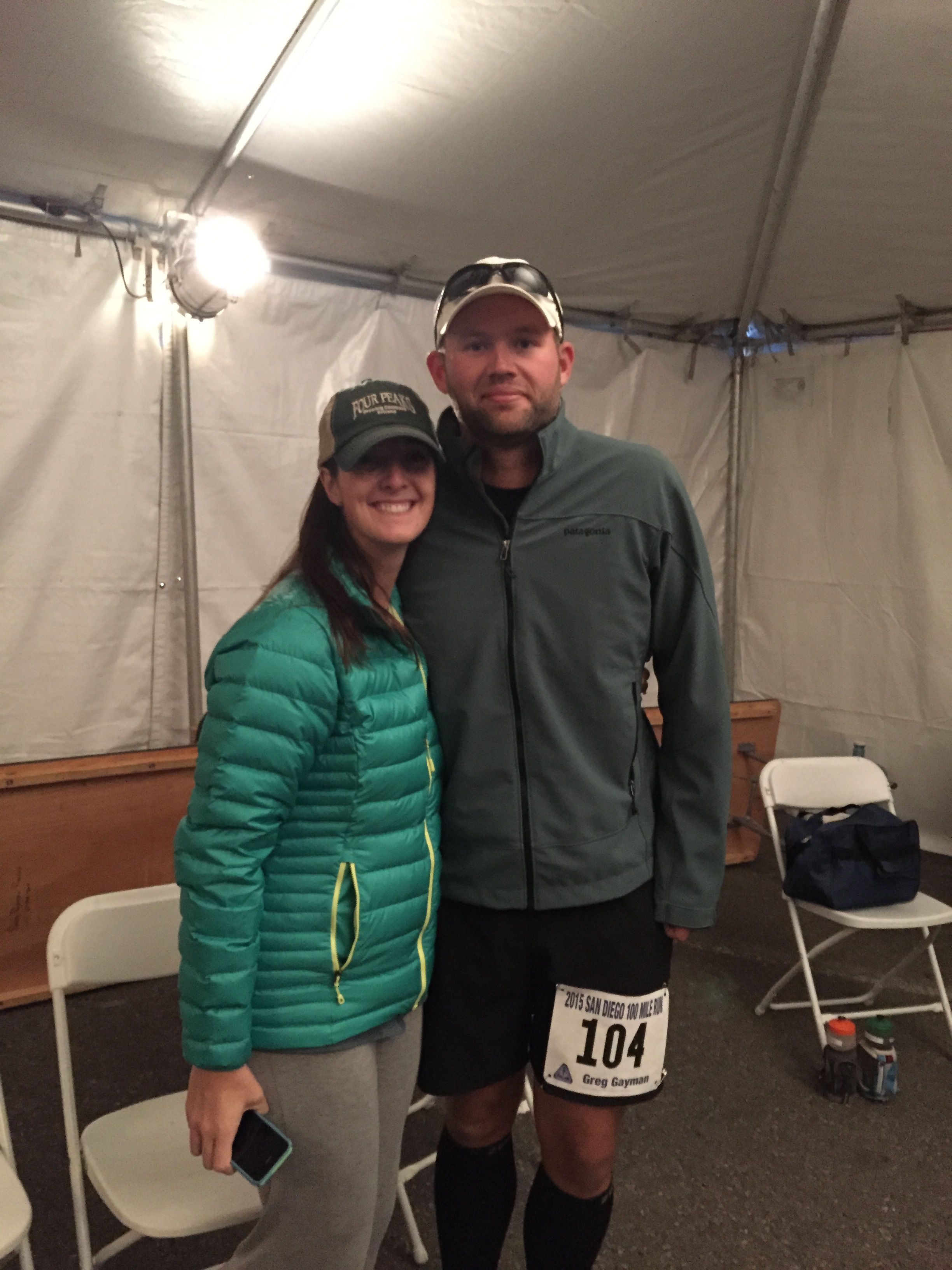
I crossed the finish line in 13:28, and couldn’t have been happier. All things considered, it was my strongest ultramarathon finish to date.

Lost Boys 50

Post race thoughts:

This race blew me away on so many levels. Running from the desert (at 1,000 feet), to the mountains (almost 7,000 feet), made for an unforgettable day of constantly changing scenery. The aid stations were so well stocked and staffed it was unbelievable. In fact, I found out later there were about 60 runners who started the race…and almost 60 volunteers helping them out.

That’s how great the ultra community is—especially the San Diego scene.

There was something else that played a significant role in my strongest finish to date, a new training device I have been using called GoMore. Stay tuned for a detailed post on my experience with the product—and how it has helped redefine the way I train.

What’s next?

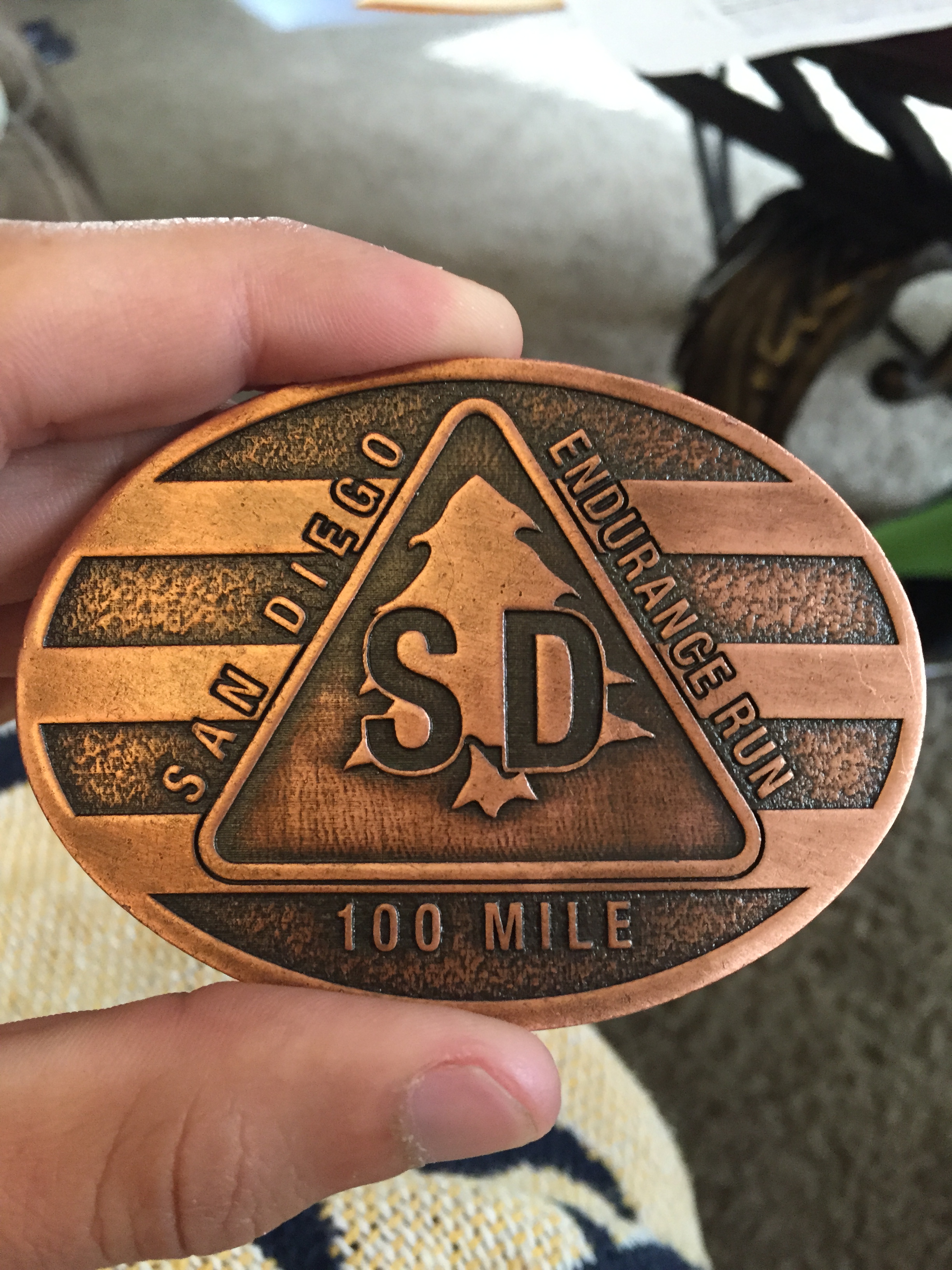
The Lost Boys 50 was my final tune-up before returning to the San Diego 100 this June. My record with the SD100 is tied at 1-1. Depending on how the final weeks of training go will determine if I take on this year’s race solo or supported.

We’ll see…

Take care,

G
 

Race Recap: The San Diego 100 — ‘Buckling’ Under Pressure

The San Diego 100 was my first 100-mile attempt last year. Though I dropped at mile 64, I vowed to return in 2015 and avenge my DNF … and this past weekend, I did just that.

After finishing the Zion 100 in April, I knew the name of the game would be to take it easy between the two races and focus on cross training and short, hilly runs. From Zion to SD I bet I only put in 50 miles on the trails. While my legs were still tired, my mind was ready to go. I’d been thinking about coming back to the SD100 ever since last year, where I found myself in the back of a pickup truck at 2 a.m., being driven out of Pine Creek (mile 64) with a truckload of others who had dropped.

Fast forward to 6/5/2015. C and I were once again on our way back out to Julian to get checked into our hotel before the pre-race brief. Once again, Race Director Scott Mills outdid himself. Check-in was smooth, and all runners were greeted by an incredibly kind army of volunteers, not to mention one of the best swag bags I’d ever seen at an ultra. But while all the swag was great, I wanted to come home with one thing: a buckle.

After the race brief, a few of us went out to dinner before calling it a night. Though I’d slept well all week, the only thing I could think about the night before was that I was back … at the San Diego 100 and that I desperately wanted to cross that finish line.

Race Day

San Diego 100-Miler
Us at the start

231 runners showed up to test their mettle against the challenging-yet-beautiful course. The race has 13,000+ feet of gain, a 32-hour cutoff and takes runners through Lake Cuyamaca, Mount Laguna, the Pacific Crest Trail and Noble Canyon, before returning to the start line. Exposure, wind, challenging terrain and almost always unpredictable weather add another layer of difficulty to an already demanding course. According to the forecast, we were in for some of the best weather the race had ever seen. So, we had that going for us.

San Diego 100-Miler
Elevation profile of the San Diego 100

At 6 a.m., we were off … and I quickly settled in toward the back. I knew if I wanted any shot at finishing this thing I needed to be honest with myself about my pace, nutrition and the fact that I still had “Zion Fatigue” in my legs.

This Looks Familiar

Runners were faced with a long, steady climb up Middle Peak right out of the gate. I fell in line with my good buddy Mark and we talked about our strategies for managing the day (note: both “strategies” would be blown up by mile 40). Once atop Middle Peak, I took some time to take in the view before running down the back side and right into and through Paso Picacho aid, mile 7.1. I was right on pace with last year.

From Paso it was up and over Stonewall Peak, and then a nice stretch through the meadow to Chambers 1. By now the party of the conga line had all but disappeared and runners were beginning to settle in for the journey ahead. I left the pirate-themed and ever-so-gracious Chambers aid station and headed across some rolling fire road and single track before arriving at Pedro Fages (mile 18.6). With about an hour in the bank, I was feeling good and continued on. Before I knew it, I was running into Sunrise 1, AKA “The Dog Pound”.

The pound is awesome. When you come in there it’s hard to tell who is having more fun, the runners or the crew and volunteers! This is the first spot where I could see C and she had everything ready that I needed, so my time here was brief.

Leaving Sunrise 1, runners head out on an unbelievably scenic stretch of the Pacific Crest Trail that overlooks the Anza Borrego Desert, nearly 5,000-6,000 feet below. It’s quite the site. It’s also the stretch that can crush unsuspecting runners with a brutal mix of elevation, wind and exposure. Last year I remembered seeing a lot of runners struggling through this stretch and adjusted my pace/nutrition accordingly. Before I knew it, I’d made it to Pioneer Mail (mile 30) and was more than an hour ahead of the cutoff. All was well.

San Diego 100-Miler
View from atop the PCT

The next point for crew access was Red Tail Roost (mile 44), so I made sure I loaded up on food/water and hit the trail, sneaking in and out of Penny Pines before making my way to Todd’s Cabin. I was proud of how I’d managed myself on this stretch of the course, as it ate several of my friends. I left Todd’s knowing that the worst was behind me (in terms of exposure), and cruised to Red Tail Roost with not a care in the world … except for the debilitating blisters that had formed over the last 10-15 miles.

Crap.

I let C know that my feet were in pretty bad shape and she and our co-crewing friend Willie wasted no time locating one of the members of the Ultra Medical Team to help me patch my feet. The gentleman’s name was Jim, and he no doubt saved my race by lancing some pretty nasty blood blisters that had formed on my feet.

Sidenote: The runners of the SD100 (and many other races) are so, SO lucky to have this fine crew of professionals out on the course. They do an AMAZING job watching out for the safety and well-being of all the runners. Hats off to you, Ultra Medical Team!

With new feet and a full stomach, I felt like a million bucks and left Red Tail Roost slightly ahead of where I was last year at that same time. While I felt great physically, memories of the same stretch last year started to creep into my mind. This is where things started to go wrong last year.

I couldn’t let it happen again.

I ran some of the most “conscious” miles of my life from Red Tail Roost (mile 44) through Meadows (mile 52) and on to Penny Pines 2 (mile 56.2), where I knew C would be waiting to start her pacing duties. As runners, we can often vividly recall some of our most profound sections of a run. This was definitely one of those for me. With a renewed spirit, I flew shuffled into Penny Pines 2 … grinning from ear to ear.

Into the Night

C and I took off from Penny Pines about 45 minutes ahead of the cutoffs. With C pacing it out we were able to get down Noble Canyon in a hurry and into Pine Creek with no real issues (other than an eye on the clock). I was so thankful to have her accompany me on this stretch, as it helped keep my mind off my DNF at Pine Creek Aid (mile 64 last year).

When we got to Pine Creek I saw Jim, the Ultra Medic who helped put my feet back together at Red Tail Roost. I told him thanks again and that they were holding up well. He said “That’s great. Now all you’ve got is a long climb up Pine Creek Road before getting on the Indian Creek Trail, where you’ll have another long climb up to Pioneer Mail 2.” My response?

O___O

In all truthfulness I knew what was coming. I was just dreading it. I’d hiked this section on an overnight training run last year and knew it would cost me a lot of time. After refueling, we were on our way up from the lowest point on the course. It was 1:15 a.m.

“Dlaaainggg” my Garmin ticked off a final mile before dying. It read 25-something minutes. Not good. With 8 miles to go and a 4:30 a.m. cutoff at Pioneer Mail, I knew it would be close. But C was all over it, and by pushing the pace (and keeping me distracted) we got to Pioneer Mail with 30 minutes to spare. She did an amazing job.

At Pioneer Mail, Mark’s friend Stephen said he’d jump in with me for the next stretch. With C acting as a 1-person crew/pacer, I knew she had been working super hard all day and could use the rest.

After thanking Stephen profusely for the kind gesture we were off … headed toward Sunrise 2.

Just Another Day

As we ran back towars Sunrise 2 on the PCT, we were greeted with one of the most amazing sunrises I’d ever seen. As the sun continued to rise, so did my spirit and before I knew it we were moving at a pretty good pace.

San Diego 100-Miler
Coming into Sunrise 2

We got to Sunrise ahead of schedule, ate some food and then Stephen said he’d go with me again. I couldn’t believe it, but took him up on the offer to run the 8-mile stretch to Chambers 2. By now it was morning and the sun was out in full force, which forced us to slow down a bit.

As we approached Chambers 2, I couldn’t help but think of being there almost a day ago on my way out. Now I was returning … only in a little worse shape.

The Home Stretch

After about 20 minutes at Chambers 2, C and I took off for the final 12- mile stretch. The final miles send runners BACK over Stonewall Peak at mile 92-ish. I’d heard my friends who finished last year talk about how brutal this was … and I can now agree with them. It was killer.

But the surprises weren’t over yet. As I stumbled into Paso Pichaco 2, I was greeted by my friend, Ultra Medic Nick, who had some “unplanned” news for me.

Nick: “So, you’ve got an easy few miles through the meadow, then a mile, mile-and-a-half climb back up Middle Peak before you run down the mountain to the finish.”

Me: “Sooo, you’re telling me we’re not running a lap around the lake this year?”

Wow. Shame on me for not checking the map closer. It turned out that they had changed the end of the course and added the substantial climb up Middle Peak in lieu of the lap around the lake.

My 45-minute buffer seemed a lot less comfortable now, so C and I high-tailed it out of the aid station with all hopes of making it to the finish in time.

The Final Push

As we started the final climb, it was pretty apparent I had nothing left. We were moving at a snail’s pace and the mental blow of not anticipating the final climb was stinging pretty bad. As we climbed up (and up and up and up), we ran into a few other people who were experiencing the same unplanned joy that we were. We had another thing in common … we were all growing more and more worried about time.

As we continued climbing, I became convinced that we were going the wrong way (the course had been subject to vandalism in prior years, in the form of people moving ribbons and mismarking the route). I didn’t think we were supposed to go all the way to the top. After confirming with a few other runners, we all agreed the way we were going HAD to be right. After what seemed like an eternity, we FINALLY saw the junction for the final descent.

Normally I’d be happy, but instead all I could think was, “Tick tock. Tick tock.”

It was 1:20 p.m. The course closed at 2 p.m. We still had a little more than 2 miles to go.

All I’ve Got

The final two miles were a big blur. C and I descended the Sugar Pine trail in a hurry, before looping around and putting the finish line in our sights.

Thanks to C’s ability to keep calm, run hard, and stay positive, we crossed the finish in 31 hours, 48 minutes … 12-minutes before the course closed.

I couldn’t believe it. We’d done it. Finished the San Diego 100!

Sitting in a folding chair, watching the last few runners come in, I couldn’t help but reflect on the day (and night … and subsequent day). C paced me for nearly 30 miles … almost all of which were unplanned. Mark’s friend Stephen was kind enough to jump in and pace a complete stranger. Ultra Medical Team gave me the feet I needed to have a fighting chance … and all the runners gave each other the strength and encouragement to keep moving forward.

What. A. Journey.

San Diego 100-Miler
Finally

Post-Race Thoughts

I’ve had people ask me which finish mattered more, Zion or San Diego. The truth is they both are two of the most important and memorable days of my life, but for very different reasons. Zion for being my first buckle, and for truly showing myself that I have the grit it takes to finish … and San Diego, for having the guts to go back and try again after dropping the year prior. My SD100 finish was also almost 2 hours FASTER than my finish at Zion, which I ran just 8 weeks prior.

Proof you can do anything if you want it bad enough.

Looking forward, my plan is to ease back into things and focus on putting in some high-quality, purposeful training. With a few races left in the year I’m hoping to make some improvements in my speed, and transition from a goal of just finishing to more time-based goals.

Take care,

G
Antelope Canyon 55K

Race Recap: Slot Canyons, Scenery and Sand – The Antelope Canyon 55K

Coming off my race at the San Diego 50 I was feeling good about getting back out on the trails and putting in miles … which is why I was so excited to head to Page, Arizona, for Ultra Adventure’s Antelope Canyon 55K last weekend.

Well, that was one of the reasons.

The other was to experience first-hand the much-talked-about scenery of the course!

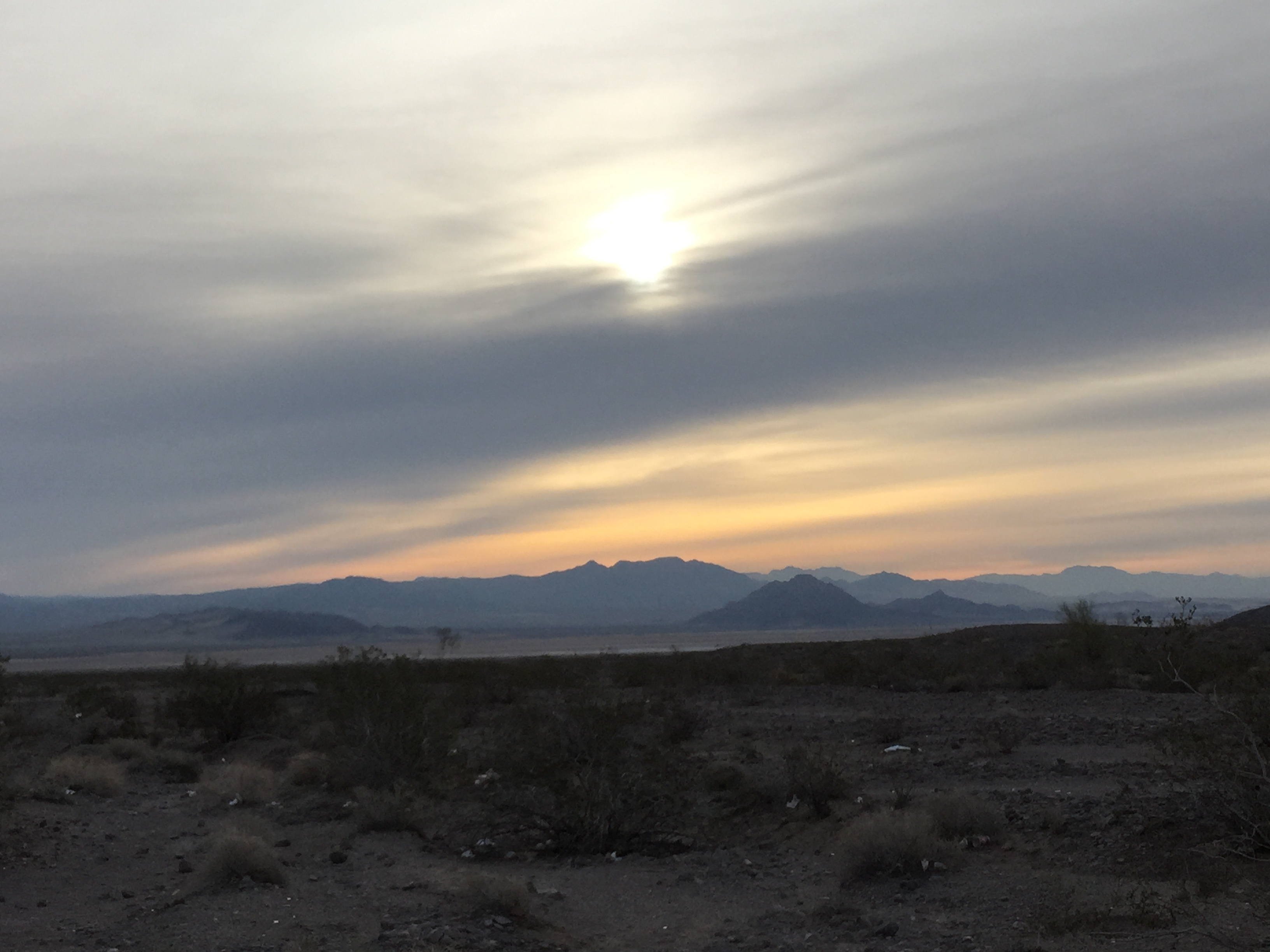
I opted to drive and left San Diego bright and early, at 4 a.m., and arrived in Page around 3:30 p.m. Not a bad drive at all; pretty scenic in parts, actually.

Antelope Canyon 55K
Sunrise over the Mojave on my way to Page

The first thing I wanted to do is complete one of the Trifecta Challenges. The Trifectas are a really cool thing Race Director Matt Gunn has put together. Realizing that these are destination races for many runners, he put together a list of “other must-see areas” while they are in town for their race. In addition to seeing more of the area, runners who participate in the Trifecta are eligible to receive discounts on future races. MORE trails and money off race registrations? No complaints here!

I was most interested in The Cable Trail, which, if followed all the way down, will take you to the Colorado River. Since I was traveling alone, I felt like going halfway down was good enough; I didn’t drive 600 miles to spend race day stuck at the bottom! Definitely an amazing trail.

Antelope Canyon 55K, Cable Trail
A bit tough to find, but definitely worth looking for!

—RACE DAY—

I got to the staging area at 6:15 a.m., got prepped and headed to the starting line. Matt gave a quick pre-race briefing, which included a moment of silence for a fellow runner’s daughter who was tragically killed in a car accident last year. In addition to the moment of silence, purple bracelets were available for runners who wanted to run for Alyssa and her family. I was one of them.

Once the briefing wrapped up, it was time to get busy. The 55K runners were off at 7 a.m. sharp.

Antelope Canyon 55K
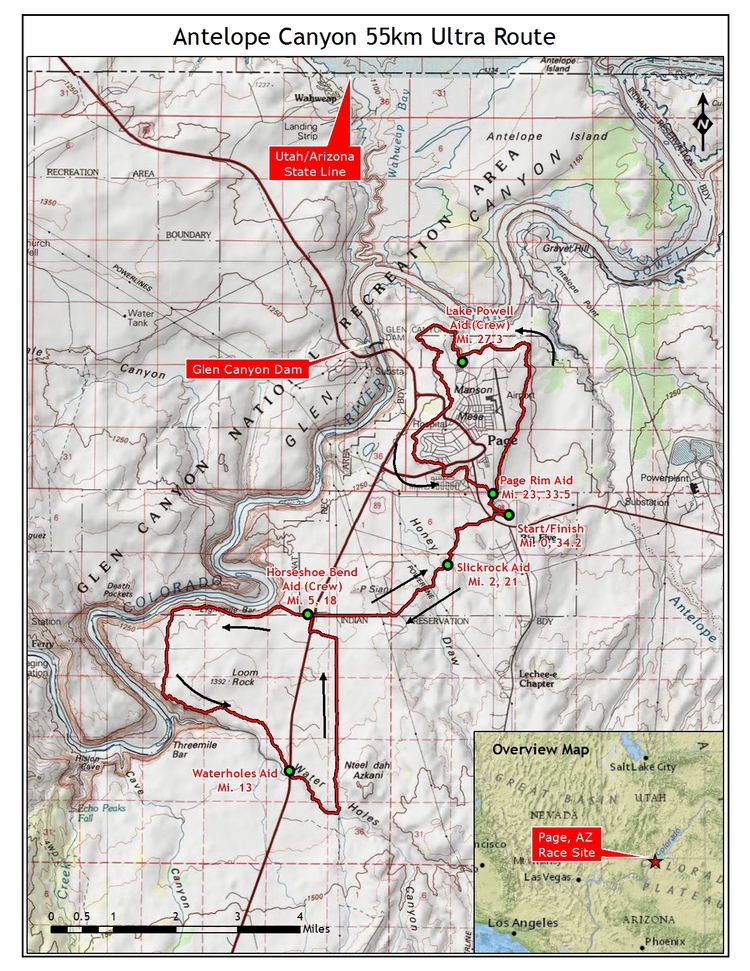
Map of the 55K course
Antelope Canyon 55K
Elevation profile for the 55K

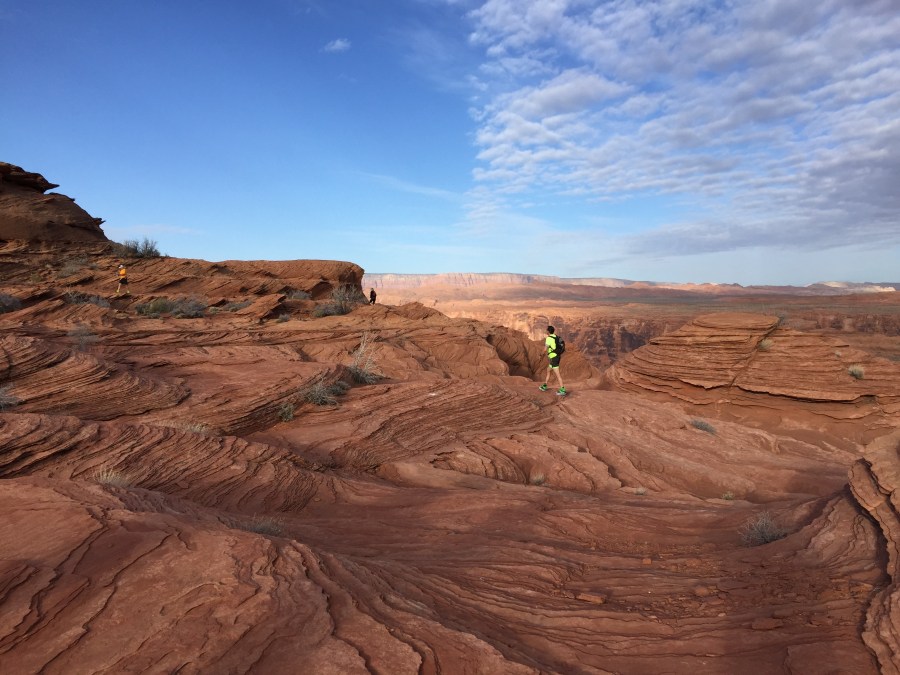
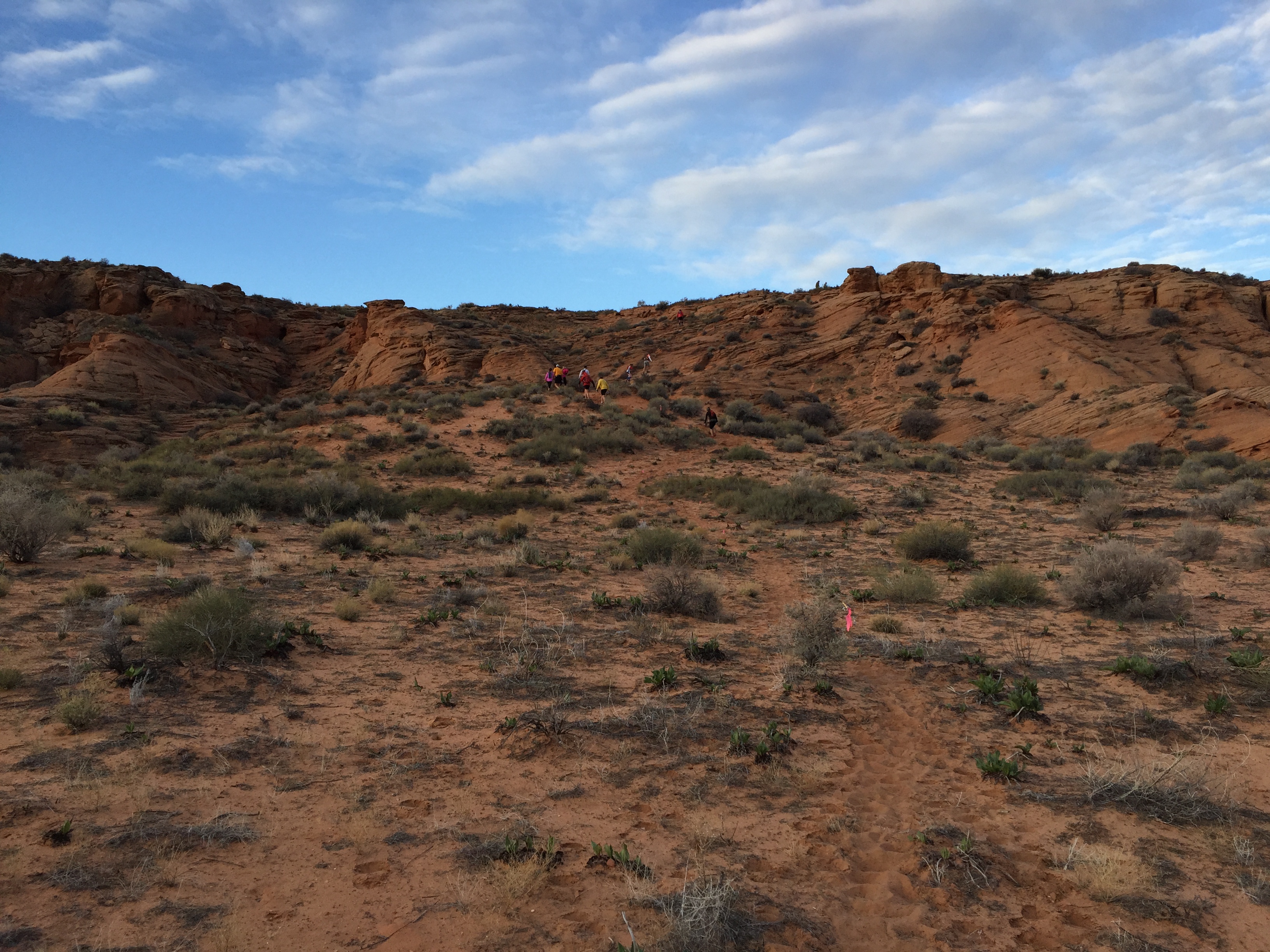
The first loop took us out through the desert toward the much-anticipated Horseshoe Bend and Waterholes slot canyon. The first thing I said after taking off was “wow, the scenery out here is going to be amazing,” followed abruptly a few miles later by “wow, this sand is going to make for an incredibly hard run.”

It most certainly did.

Antelope Canyon 55K
Trudging through the sand early on

Since I’m making a more concerted effort to not waste too much time at aid stations this year, I went straight through Horseshoe Bend aid (mile 5) and continued on toward the river.

Antelope Canyon 55K, Horsehoe Bend
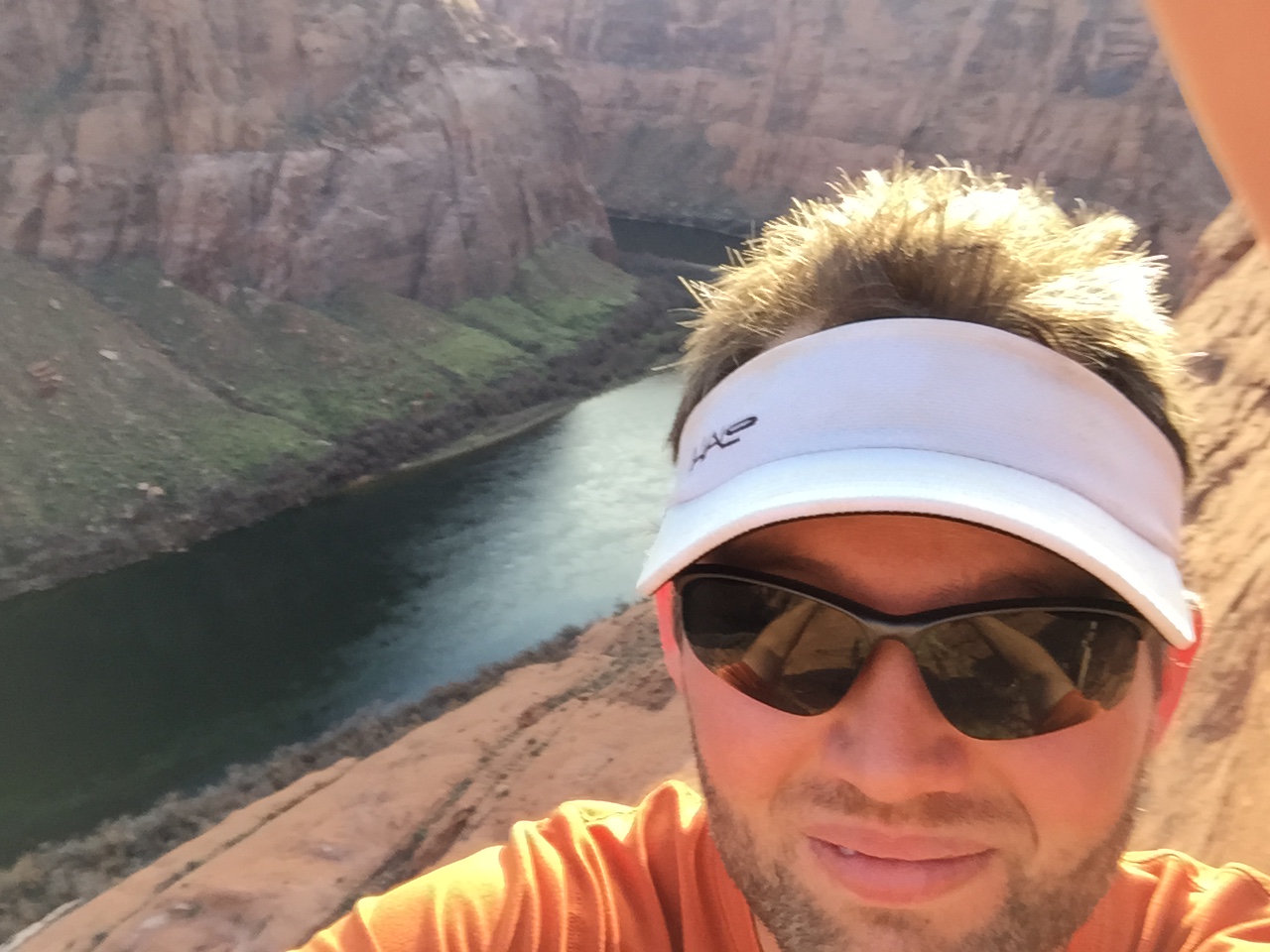
Me at Horseshoe Bend
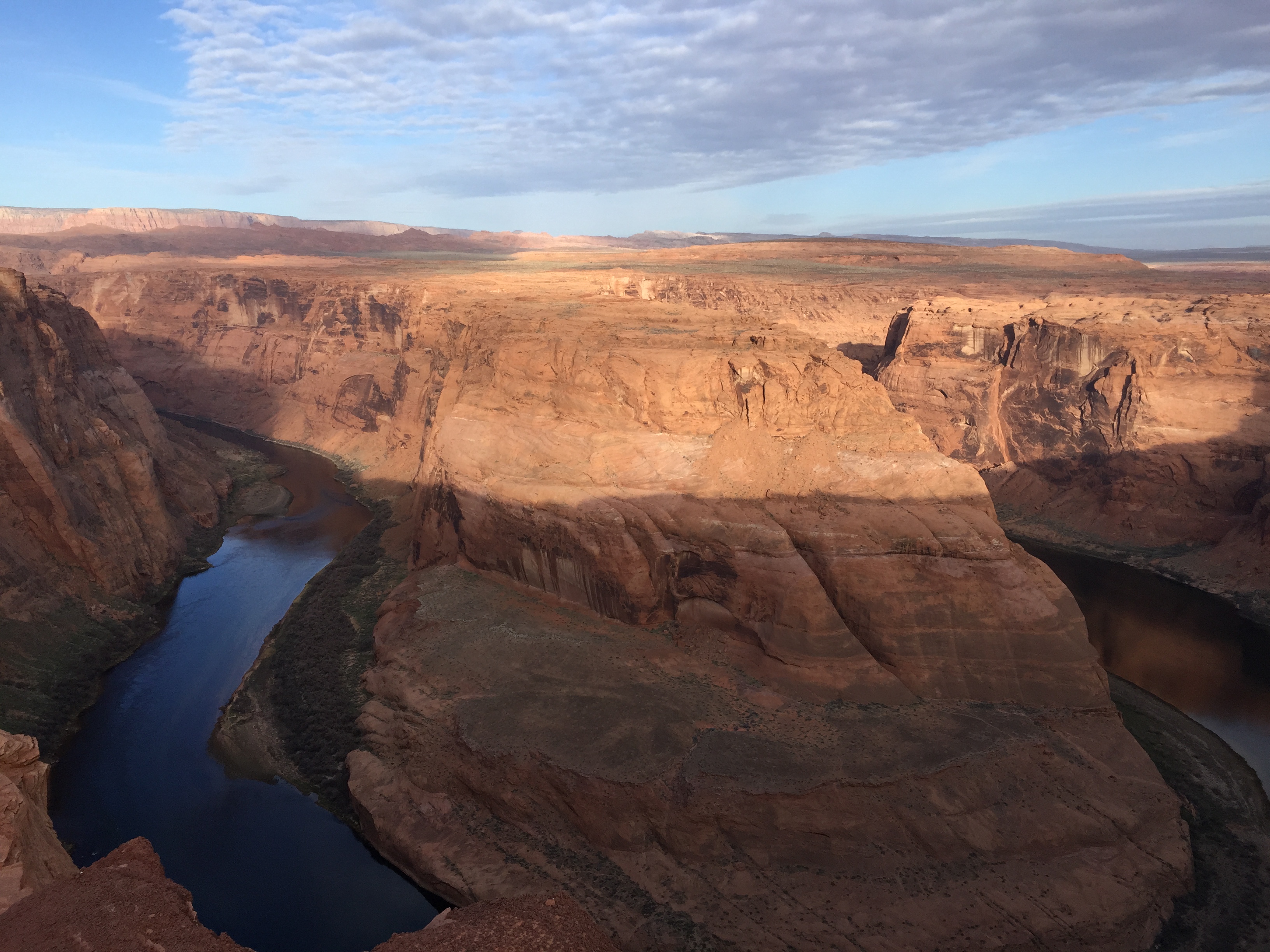
Antelope Canyon 55K, Horseshoe Bend
Absolutely amazing

Standing over Horseshoe Bend was one of the most surreal moments I’ve ever experienced. Billed as one of the most photographed land features in the country, I definitely added to the picture count by snapping 20-30 pictures on my iPhone.

Once I picked up my jaw from the ground, I continued on my way.

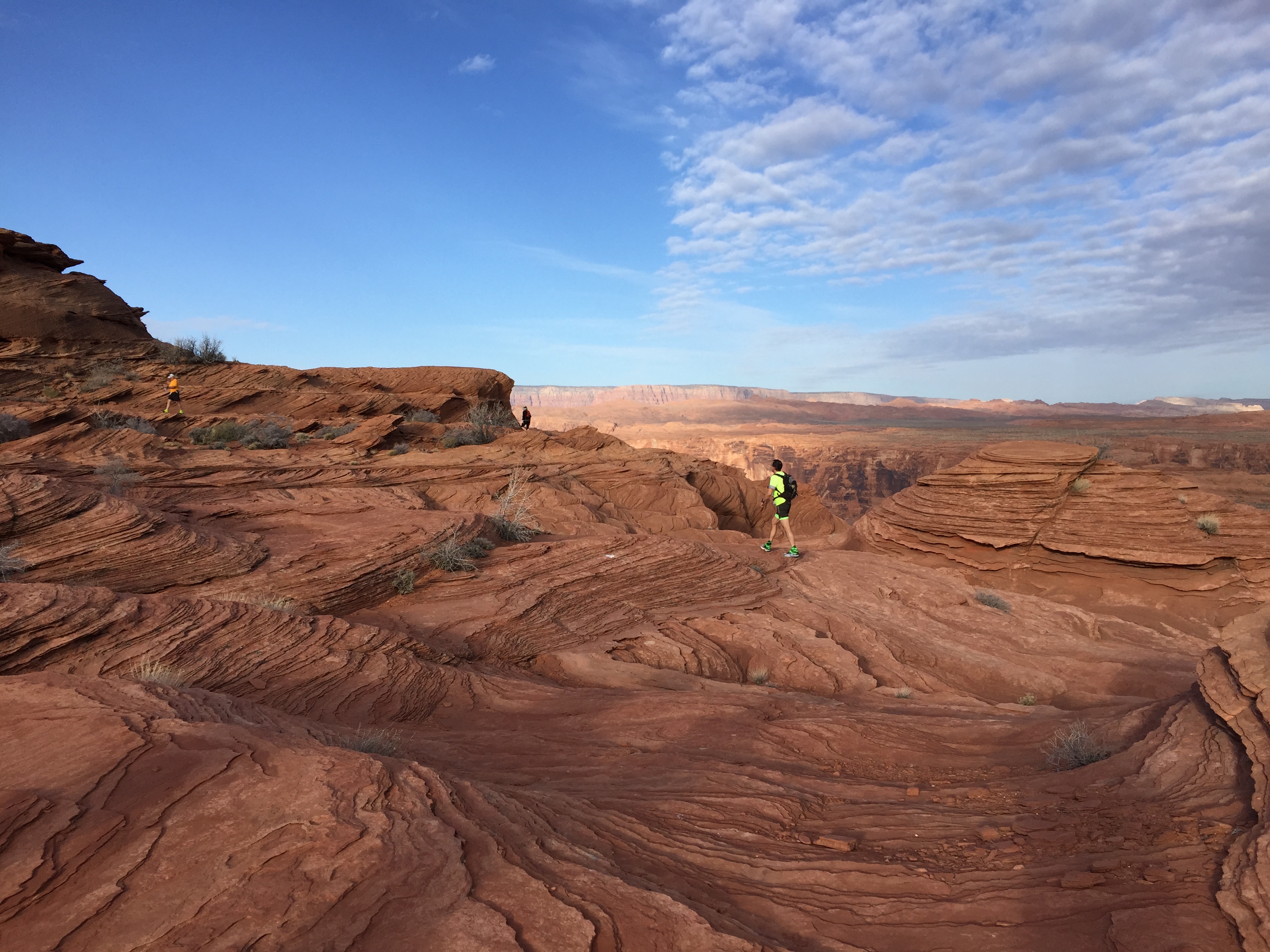
One thing that quickly became apparent was the fact that you’d be running on a wide variety of terrain. Running on the slickrock overlooking the river was an awesome experience – but one where I had to stay pretty aware of where my feet were landing so not to injure myself.

Antelope Canyon 55K
Careful!

All went well and I hit Waterholes Aid with no issues before dropping into Waterholes slot canyon.

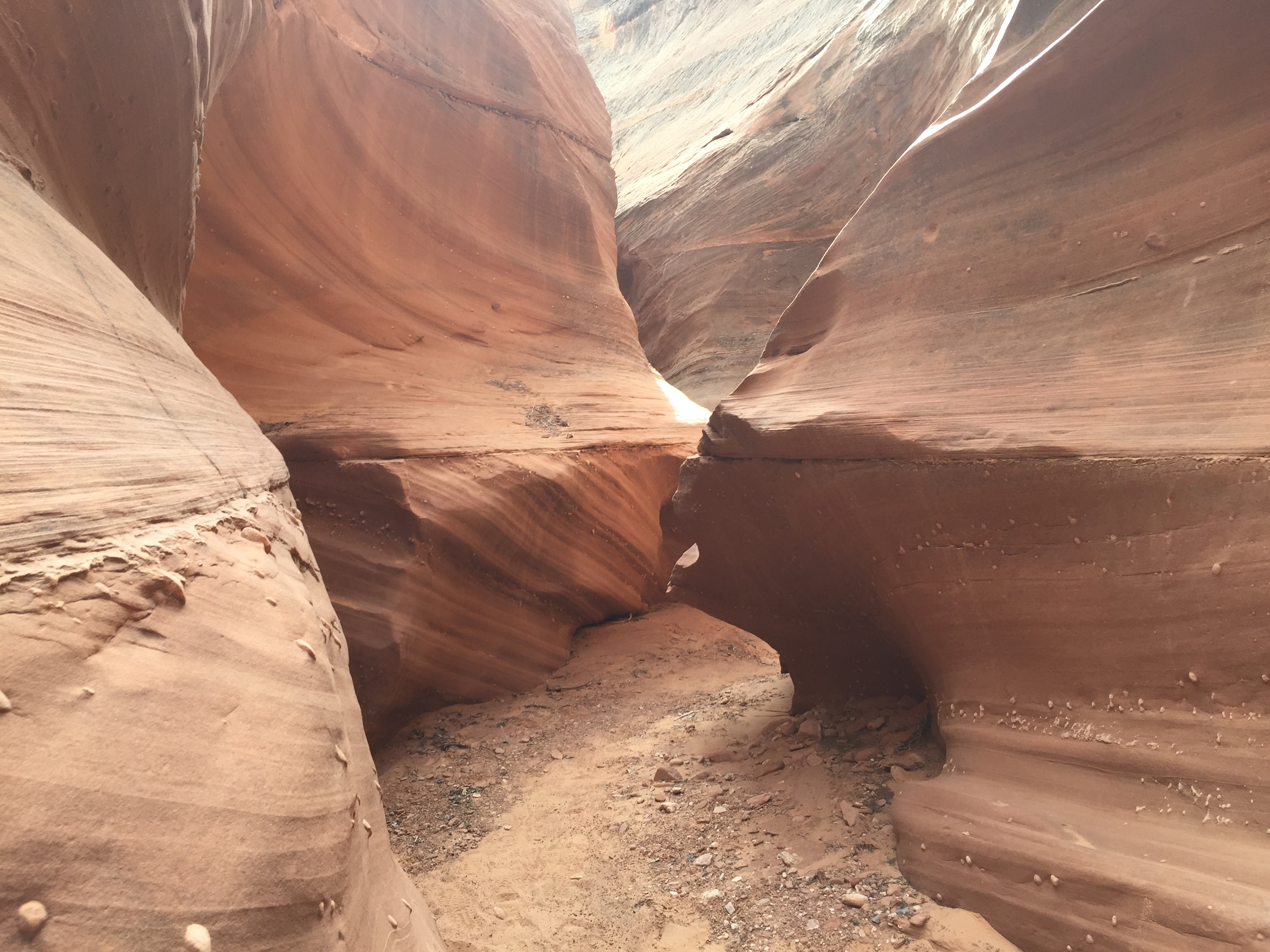
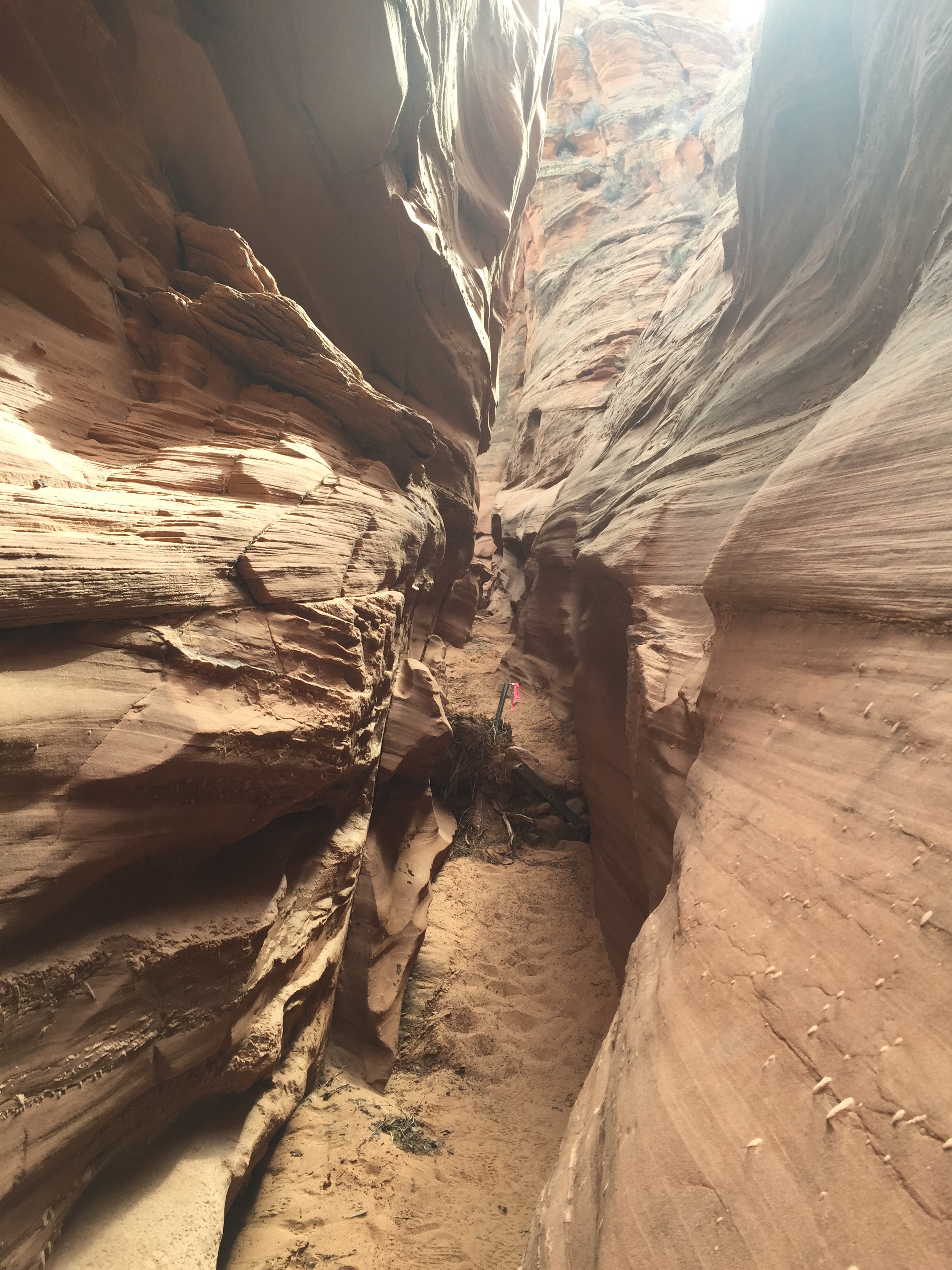
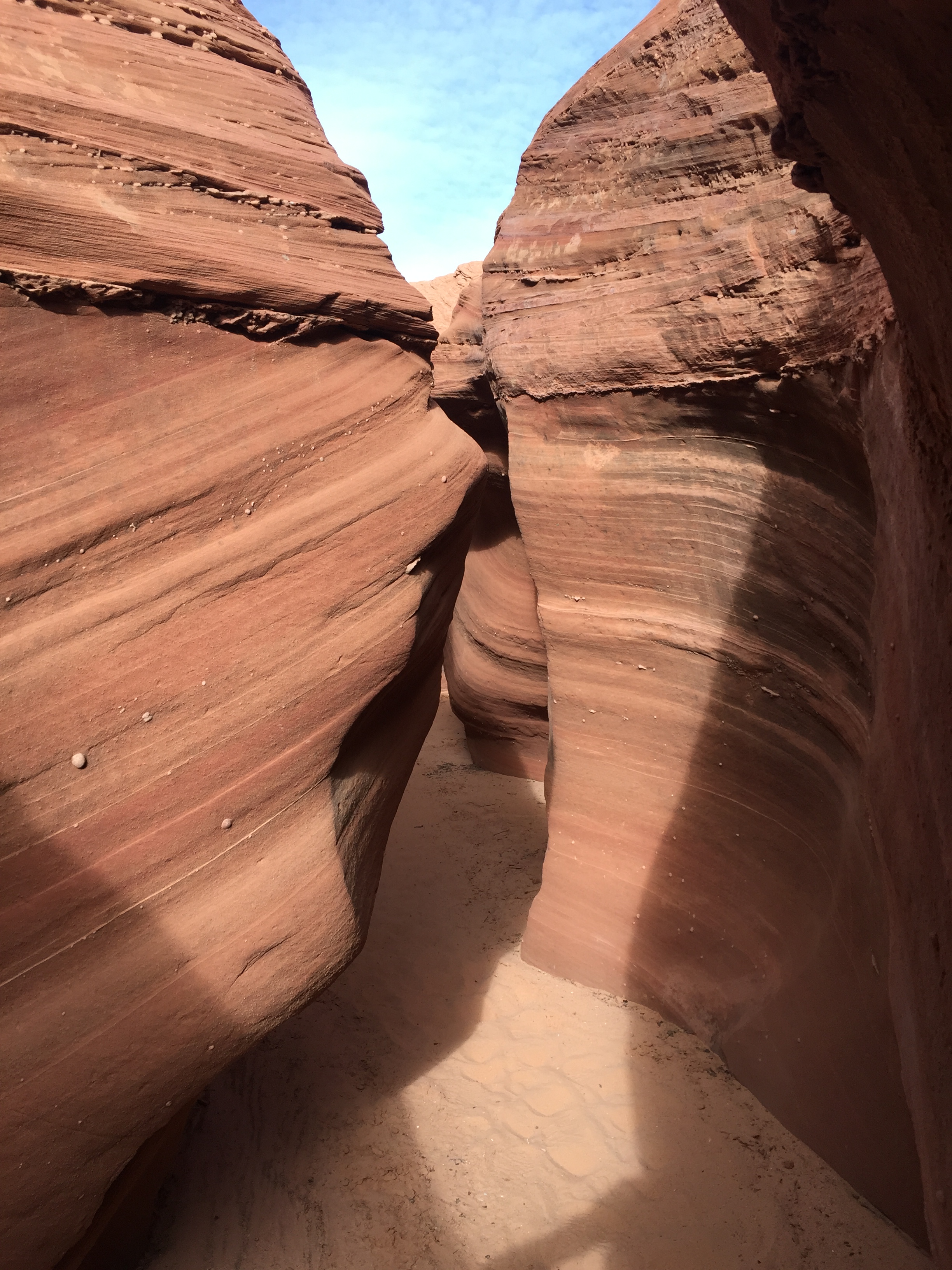
Runners were pretty spread out by this point, which allowed me to experience Waterholes slot canyon alone. It was an awesome experience. I’d like to try and capture it in words, but I think pictures tell the story better:

Antelope Canyon 55K, slot canyon
Entrance to Waterholes
Antelope Canyon 55K, slot canyon
Somewhere in the middle
Antelope Canyon 55K, slot canyon
Continuing on through
Antelope Canyon 55K, slot canyon
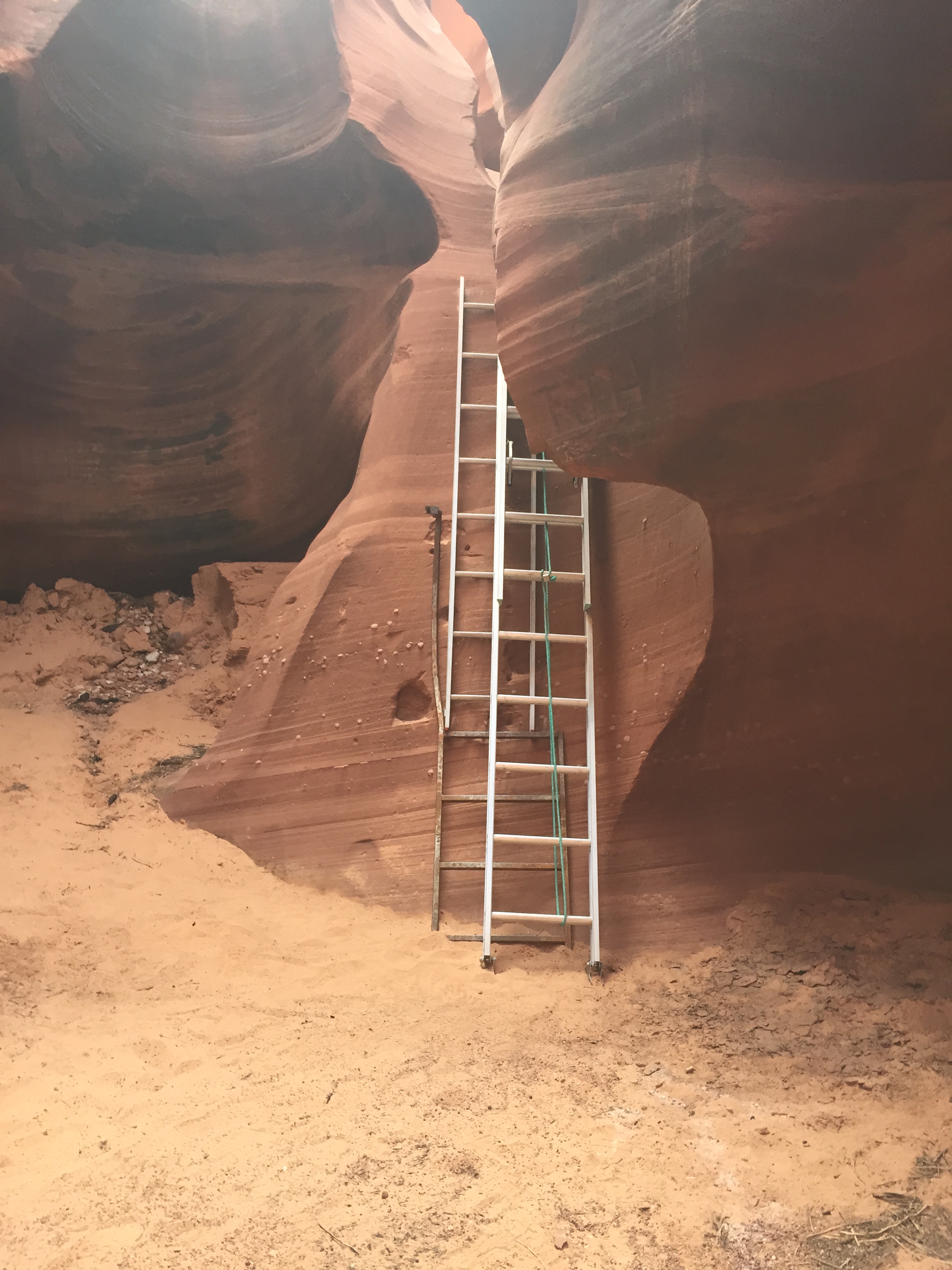
Ladders to get out

Once out of Waterholes it was some fire road, followed by a quick pass back through Horseshoe Bend aid, before heading back toward the staging area. The first “loop” was about 23-ish miles.

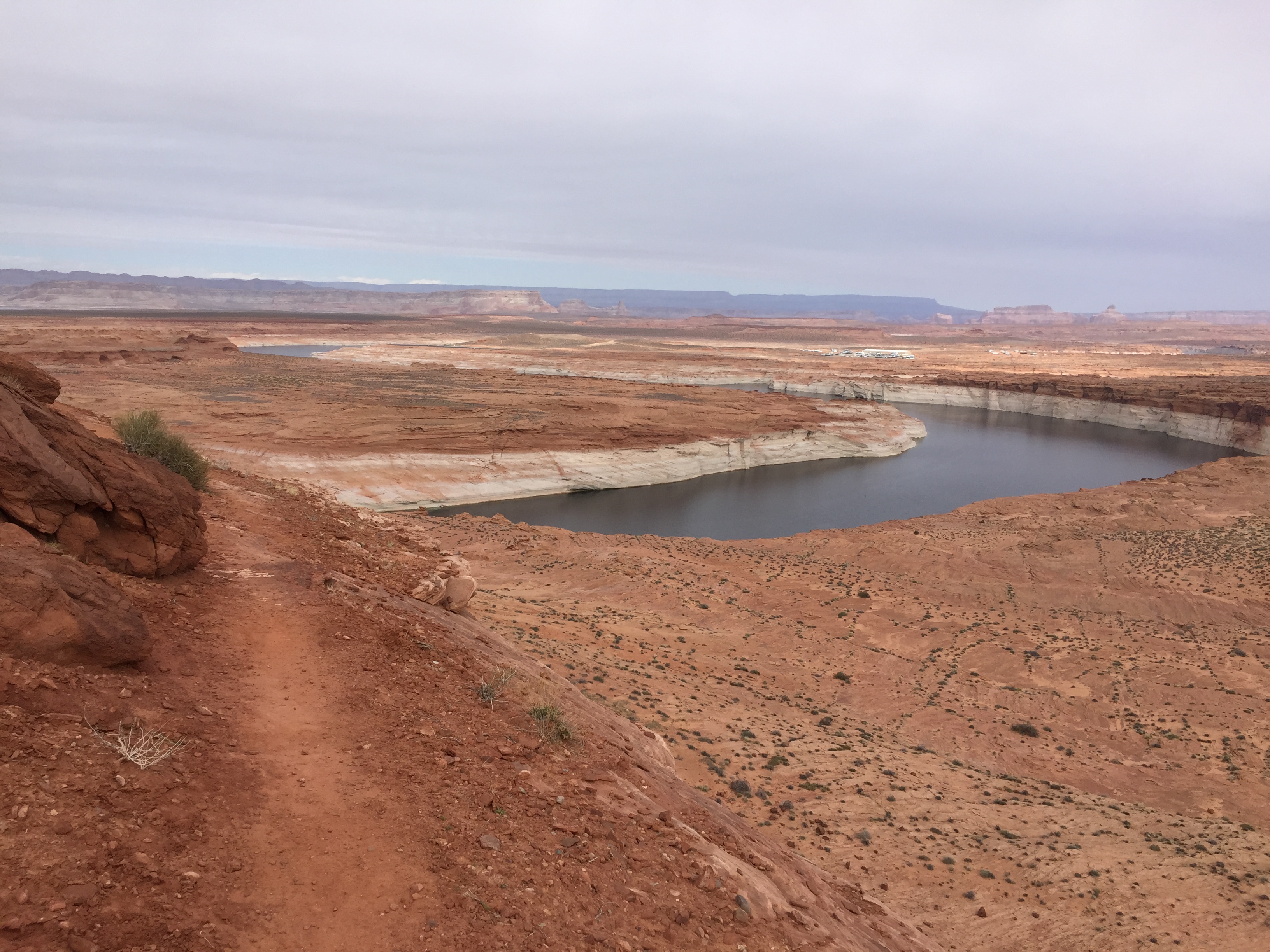
The 55K finished up with a lap on the Page Rim Trail, a 10-mile loop of scenic singletrack that encircles the city of Page and gives runners amazing views of Lake Powell and the surrounding area.

Antelope Canyon 55K, Page Rim Trail
Awesome views from the trail

I crossed the finish line in 8:26, somewhere in the middle of the pack. I was definitely happy with the effort and think that I’m improving each and every day.

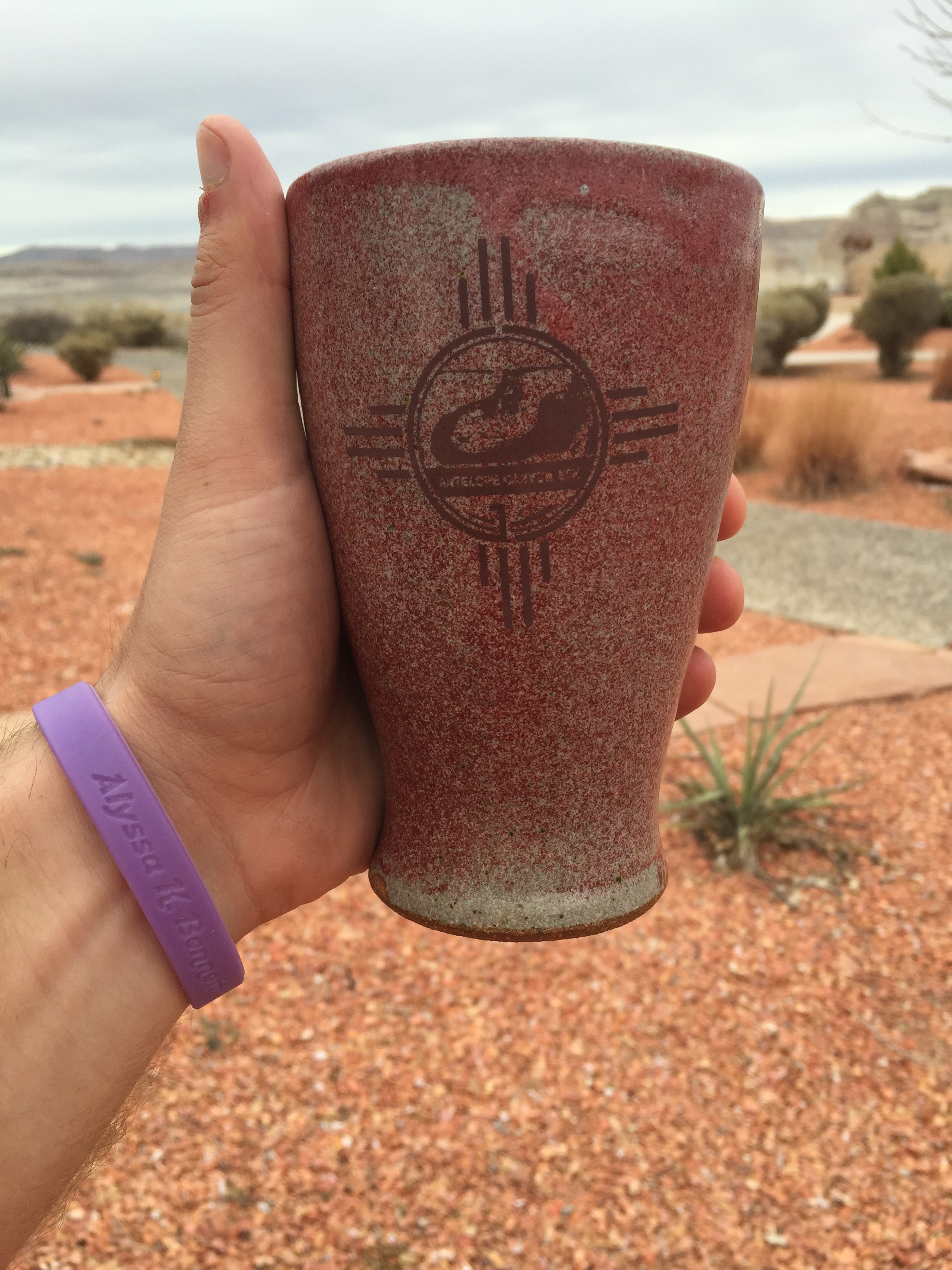
Finishers’ awards for the 55K were handcrafted pieces of pottery that were each unique – and way cooler than a medal (in my opinion). I also really liked how you got to pick your own award based on which one spoke to you the most.

Antelope Canyon 55K
Awesome finisher awards

But I was given so much more than a finisher’s award. Antelope Canyon gave me the opportunity to run through some of the most memorable and breathtaking scenery in the country, and to do it in support of a fellow runner who had experienced a significant loss. Thinking of him and his family throughout the day really put life into perspective for me.

It should be noted that the runner who lost his daughter committed to running the Antelope Canyon 100-mile race in her memory. It was his first 100-miler. He finished strong and I’m sure his daughter is incredibly proud.

I know I am.

—POST-RACE THOUGHTS—

A week has passed since the race, and I’m still replaying a lot of it in my mind. I’ve also had some time to think more about the event and here’s what I came up with:

  • I loved that Antelope Canyon was not only a race, but an adventure. Using ladders to get in and out of slot canyons, bushwhacking to get to The Cable Trail, running on slickrock overlooking the Colorado River – all of these things added so much to the experience.
  • I’m becoming more and more interested in destination races that offer an opportunity to run through scenic areas.
  • The event was incredibly well-supported, well-marked, and lived up to what it said it would offer on the website.
  • It’s important that we take care of the areas where we run. I really admire Ultra Adventures for living up to their commitment of hosting a zero-waste event.
  • Never … EVER … judge a race by its elevation profile. Running through sand for extended periods of time is really, really hard! Not to mention scurrying across slickrock and climbing up and down ladders.

My experience at Antelope Canyon confirmed one thing: I need to run more of these events to see more of the The Grand Circle. But I won’t have to wait too long; I’ve got two more UA races on my calendar, Monument Valley and Zion.

Zion will be my second attempt at the 100-mile distance … and I can’t wait.

Take care,

Greg

This was my first race as part of the Ultra Adventures ambassador team. For more information on Ultra Adventures races please visit their website. You’ll be glad you did!

Race Recap: The San Diego 100-Mile Endurance Run—My First DNF

It’s been more than three weeks since my first DNF at mile 64 of the San Diego 100-Mile Endurance Run.  In that time I’ve replayed the race a hundred times in my head, analyzed the highs and lows, and have come to the following conclusion: I needed that. But I’ll explain what I mean by that later. Here’s the recap:

C and I picked up my buddy Mark—who was also running—and headed out to the pre-race meeting at Lake Cuyamaca. Once we got out there I saw several other people whom I had trained with and had the chance to chat and check in with them all. Race Director Scott Mills gave a great pre-race briefing, and then it was off to our hotel for the night in Julian.

SD100
The pre-race briefing

I slept surprisingly well and was up by 3:45 a.m. getting ready and at the start line by 5. The next hour was the worst. I just wanted to start running!

SD100 At 6 am sharp, I got my wish and 222 runners took off from the start.

Lake Cuyamaca – Paso Picacho 1 (0 – 6.8)

The first section had about 1,300’ of gain so I took it easy, settled in and climbed. My strategy for the day would be simple: walk the ups, jog the flats, and run the downs.

Paso Picacho 1 – Chambers 1 (6.8 – 12.5)

After a brief pitstop, it was time to head up and over Stonewall Peak. By now, runners had spread out a bit more, which was nice. Before I knew it, I was up and over Stonewall and running through the fields nearby, still feeling great.

SD100
View from the stop of Stonewall Peak

Chambers 1 – Pedro Fages (12.5 – 18.5)

I checked in and out of Chambers in less than 5 minutes and continued on my way. Not a lot to report on this section other than some beautiful singletrack.

SD100
Heading into Anza Borrego

Pedro Fages – Sunrise 1 (18.5 – 23.2)

I got into Pedro Fages and was ahead of the cutoffs by and hour. I was feeling good and was managing my nutrition and hydration pretty well, too. The next stretch left the runners pretty exposed, and as the day wore on, it quickly became apparent that the “heat” was wearing runners down.

I say “heat” because, while it didn’t necessarily feel hot out there, there was nothing protecting the runners from that sun! Staying on top of electrolytes and hydration became paramount. Before I knew it I was rolling into the Sunrise 1 and was incredibly excited to see Christina there (Sunrise was the first spot for crew access).

SD100
Coming into Sunrise 1

Sunrise 1 – Pioneer Mail 1 (23.2 – 30.4)

After talking with C and Jessica (my buddy Mark’s girlfriend), I was out of there and back on my way. Oh, and the views got better, too.

SD100
Great view from the Laguna Mountains

Pioneer Mail 1—Penny Pines 1 (30.4 – 34.4)

Felt great here and actually started getting some time in the bank, which felt great.

Penny Pines 1 – Todd’s Cabin (34.4 – 39.6)

Nothing much to report here.

Todd’s Cabin – Red Tail Roost (39.6 – 44.7)

I had run this area on several training runs (as well as during the PCT 50), so knowing what was just ahead was helpful. I’d caught up to several other runners I’d trained with in the months prior and we ran it in towards Red Tail Roost.

SD100
The last photo before my phone died

Red Tail Roost – Meadows (44.7 – 51.1)

As I came into Red Tail Roost, I was still feeling good – but was hungry. I knew I’d been on the move all day (in and out of aid stations in less than 5-7 minutes) and hadn’t rested much at all, due to skirting some of the cutoffs. I decided to sit, and have some real food before heading out and picking up my pacer at Meadows.

Boy, things did NOT work out like that.

I left Red Tail Roost feeling good, but didn’t get more than a half-mile out when I got an unbelievably intense sharp pain in the bottom of my forefoot. Sharp enough to stop me in my tracks. Now, I’ve had blisters, and “sore” feet, but this was unlike anything I’d ever felt.

I stopped and started walking, noticing that if I kept my weight off my forefoot I could at least keep moving. So, move along I did … all the way into Meadows, but my running had been replaced with a slow walk.

Meadows – Penny Pines 2 (51.1 – 56.3)

It was dark by now, and the last section had cost me dearly in regards to time. I was back to less than an hour to hit the cutoffs. Not a place I wanted to be with a bum foot.

I picked up my pacer, Paul, who was gracious enough to offer to pace me on my first 100. At this point I felt like I owed it to him to keep going. He had been out there for a few hours and I wanted to desperately believe that this pain would subside and I’d be able to keep going. I modified my stride and incorporated a walk/run and somehow managed to get to Penny Pines 2.

Penny Pines 2 – Pine Creek (56.3 – 64)

We got to Penny Pines 2, and Paul could tell that I was hurting pretty bad. I’d dropped pretty far behind him and couldn’t shuffle along for much more than 20-30 yards without having to stop.

To say I was thinking clearly at this point is probably inaccurate, but aside from the physical pain, I was mentally and nutritionally still very much in this race and wanted to believe that I could keep going. I left Penny Pines with Paul and was still somehow managing to make forward progress, even though we were predominately walking by this point.

Then, it happened. My foot literally “gave out” and I couldn’t put any more pressure on it. Zero. And I knew right there … I’d be getting my first DNF in the San Diego 100.

After a brief mini blow up of emotions—frustration, anger, sadness, etc.—I pulled myself together and slowly (read: very, very, VERY slowly & with the help of Paul) made it to the next aid station, where I turned in my bib (I’d missed the cut off by 20 minutes).

My first attempt at 100-miler would end at Mile 64, Pine Creek, after 19 ½ hours on my feet.

-3 Weeks Later-

If my recap seems a bit blurry compared to ones in the past it’s because it is. The past three weeks have been full of me replaying the race in my head, asking myself tons of questions about what I could have done differently, and self-diagnosing myself through research. At first I was determined to find out what went wrong.

  • Was I undertrained?
  • Had I not tapered properly?
  • Was running in minimalist-style shoes a bad idea for me?
  • Did running the PCT 50 just four weeks prior set me up for an overuse injury?

The questions went on and on, which is one of the reasons it took so long for me to write this post.

After three weeks, and a lot of questions, I believe I have the answer and–regardless of what happened out there—my reasoning for not finishing was much simpler than I wanted to believe.

It just simply wasn’t my day.

Once I was able to accept that, I was able to move on and begin again. Which is exactly what I did yesterday, as I went out on my first run since the race. Time to start looking forward and stop dwelling on the past. That’s what it’s all about, right? Relentless Forward Progress.

Man, I needed that.

Race Recap: PCT 50 Mile Ultramarathon

I signed up for the PCT 50 as soon as it opened back in January … and it was a good thing I did. The race sold out in just a few days! After doing some research and spending some time out on the trail itself, it was quick to understand why: The Pacific Crest Trail is absolutely beautiful.

The race was ran primarily on single track trail in the Cleveland National Forest, and provided unbelievable views at altitudes ranging from 3,000-6,000 feet. The race also boasted 7,500 feet of elevation gain. Needless to say, today would not have been the day to forget my race pack!

With the race start being about an hour east of San Diego, we got up at 3 a.m., picked up my buddy Mark, and headed out. We got to the start (Boulder Oaks Campground) about 5:15 a.m., just in time to pick up our packets, say hello to some running friends, and get those last few pre-race jitters out. And then—before I knew it—I heard “3 … 2 … 1!”

We were off.

PCT 50
Runners preparing to go at the start

Boulder Oaks Campground – Fred Canyon Road (0.0 – 6.4)

The race wasted no time in sending us “up”. My strategy for the first part of the race was simple: fall towards the back and power-hike the first 14 miles, since they were mainly uphill. I ran the flats and downs but wanted to conserve as much energy as I could, which made this stretch pretty uneventful.

PCT 50
A.M. reflection on the PCT

Fred Canyon Road – Dale’s (6.4 – 13.7)

I arrived at Fred Canyon aid station with no trouble. I topped off my bottles (one with water, one mixed with lemon-lime First Endurance EFS & Carbo Pro), grabbed some pretzels and an orange, and took off to continue my climb. The trail got a lot more technical during this stretch, which meant I spent a lot of time looking at the ground instead of the scenery, but before I knew it was rolling into Dale’s aid station.

PCT 50
Climbing on the PCT

 Dale’s – Todd’s Cabin (13.7 – 17.5)

After a quick pit stop, I was back on the trail and on my way. I knew the next few miles were predominately flat, so my plan was to hammer them out as quickly as I could. This stretch was mainly shaded single track, so it was the ideal place to bank some quick miles while getting a break from the sun.

PCT 50
Solitude out on the PCT

Todd’s Cabin – Penny Pines 1 (17.5 – 22.7)

I cruised into Todd’s cabin, quickly remembering how much tougher it is to run at elevation than it is at sea level (where we live). Luckily, I had run the next 5 miles on a previous training run, so I knew when to conserve/when to push. The scenery was crazy. Apparently, several years prior, the area had experienced a massive fire that scorched the earth. It felt like you were running on a different planet at times. I started hiking up the last big climb to Penny Pines and could see C at the top waiting for me. What a great sight that was!

(Sidenote: C, and all the volunteers, crewers, pacers, medics and sweepers who donate their time and energy to helping make the runners’ day successful deserve the biggest, most sincere THANK YOU I could possibly offer. You guys/girls are simply amazing. Thank you.)

PCT 50
View from up top

Penny Pines 1 – Turnaround (22.7 – 25)

As soon as I got to Penny Pines, C went to work getting my bottles filled and making sure I had everything I’d need. My pacer, John, had also just shown up and was preparing to run the last 25 miles with me. I was talking with them when I overheard someone say “cutoff time.” I froze. It was 11:40, and all runners would need to be back through Penny Pines by 1:30. John looked at me … I looked at C … we all looked at each other, and I busted ass back out onto the trail.

PCT 50
Grabbing some fuel at Penny Pines

Note to self: pay more attention to cutoff times!

Turnaround – Penny Pines 2 (25 – 27.3)

I couldn’t believe I could have been so careless. Although hiking the uphill at the beginning was allowing for some pretty fresh legs here – my back was now against the wall and I was going to have to work hard to stay ahead of the cutoffs on my return. Luckily this section was pretty much rolling single track and I was able to cruise pretty quick back into Penny Pines.

Penny Pines 2 – Todd’s Cabin (27.3 – 32.5)

I came back through Penny Pines, picked up John, and we were off – ahead of the cutoff by about 40 minutes. We started on our way back and were making pretty good time, passing several runners along the way. Although it wasn’t hot, per se, this section of the PCT left you pretty exposed, and I could tell the sun was starting to hit me pretty hard. However, the spectacular views of the Anza Borrego Desert nearly 5,500 feet below made the trip pretty enjoyable. As great as the views were, I’d be lying if I said I wasn’t checking my watch continuously … the cutoff at Todd’s was 2:30.

PCT 50
On the way to Todd’s Cabin

 Todd’s Cabin – Dale’s (32.5 – 36.3)

John pushed me pretty hard on the return and got me in (and out!) of Todd’s Cabin by 2:15. The return stretch here was pretty rough for me, as I could feel two hot spots on my feet starting to flare up. This resulted in some sort of walk-run-shuffle-tiptoe-forward motion that somehow got me to Dale’s.

PCT 50
Heading to Dale’s

Dale’s – Fred Canyon Road (36.3 – 43.6)

There was no cut off here, but they informed us that there would be a final cutoff at Fred Canyon at 5:30 p.m. Needless to say, we grabbed what we could and took off. While I’m not a huge proponent of out-and-back courses, I will say that it was nice to know exactly what type of terrain I had to run over to get back to Fred Canyon in time.

Fred Canyon Road – Finish (43.6 – 50)

I made it to Fred Canyon by 4:55, and saw my friend Mark there getting ready to head back out. We all ran together for the first few miles, then we split up. My return to the finish was FAST! Probably some of the quickest miles of the day for me – all over some pretty technical and rocky trail. As we descended the final few switchbacks, I couldn’t help but smile. My strategy had worked!

PCT 50
PCT 50: Complete

I crossed the finish in 12:32:32—a 17-minute PR at the 50-mile distance—on the most difficult course I’ve run to date.

Overall, I’m incredibly happy with how the day went. It’s funny, as with any race, I learned so much that will be valuable for future races. Although I was feeling a bit stressed on the start of my return, I do not regret my decision to power hike the start. Yes, I lost a decent amount of time there, but it resulted in an incredibly strong finish, with enough in the tank to keep going if I needed to. In conclusion: Physically, mentally and nutritionally, things clicked.

Thoughts Looking Forward

As many of you may, or may not, know, I’m running the San Diego 100 Endurance Run on June 7. The PCT 50 was my last long run before that race. If you’ve followed along, I’m sure you’ve noticed my last few tune up races have had all kinds of issues, leaving me feeling a bit uneasy. Yesterday’s race, however, erased all of that and provided me with the confidence I needed to be able to toe the line on June 7.

Take care,

-G

Race Recap: Oriflamme 50K Ultramarathon

The Old West Trails race did exactly what it was supposed to: get me back on track. With a several good weeks of training in, I was excited to see how things would go for me at Oriflamme.

We arrived at the race start at about 6:30 a.m., got checked in, and then went back to the car to stay warm. While we were in the car talking, I noticed C start glancing around, looking behind the seats, in the back, etc., but didn’t think much of it. I didn’t think much of it until she turned to me and said “Where’s your hydration pack?”

Oh, shit!

After a rather intense 2-3 minute freak out, I came to the realization that in my zombie-like state at 3:30 a.m., I had left at it home and there was absolutely nothing I could do about it. Luckily, I saw my buddy Mark at the start and he said he had an extra vest with ONE 20-ounce water bottle that I could use. (I usually carry 2 20-ounce bottles AND a 70-ounce hydration bladder).

So, with a borrowed vest and some scrounged-up food (one Pro Meal bar and a single GU) I went up to the start line, knowing full well I had no idea what I was in for.

It was cold and rainy at the start and all I could do is think about how my pack was doing at home, resting in the warm apartment on the back of the kitchen chair. I couldn’t think about it for long, though, because before I knew it – we were off!

A cold and rainy/snowy start – but you can see the sun coming up in the desert below.
111
My friend John (left) and the rest of us heading out.

The first five miles were on some rolling single track that’s part of the Pacific Crest Trail. Everyone fell into line and we all marched along. We caught word at the start that the aid station that was supposed to be at mile 5.4 wouldn’t be there. Apparently the car got stuck, so the first official aid station wouldn’t be until mile 13.2.

112

Once through the first would-be aid station, we started our roughly 5-mile descent to the desert floor. Part of my strategy was to take it relatively easy on the downhill, as I still knew I would have to climb back UP this trail on the way back (about 2,000 feet).

Heading down Oriflamme Canyon.

Once at the bottom I picked up my pace on the fire road and ran it all the way into the first aid station at mile 13.2. By the time I got there I was starving (I was saving my bar for the climb out – as I KNEW I’d need the calories). I dined buffet-style at the aid station, grabbed a few gels and took off toward the turnaround.

Sandy down on the desert floor.
My new Dirty Girl Gaiters really performed well!

C was waiting for me at the turnaround, and I could tell she was a bit worried about what shape I was going to be in. All in all, I had managed to refuel pretty well at the 13.2 aid station, so at the moment I was feeling pretty good! I hit the turnaround in about 3 hours 10 minutes and knew the toughest part was yet to come.

I cruised through the desert, reloaded at the aid station and started heading toward the big climb up Oriflamme Canyon. I ate half my bar and started powering up the hill – but not for long. I bonked. Hard.

130
The start of the climb up

The run hike out was long, slow, hot and generally miserable. I was WAY undernourished and it was really starting to show. Regardless, I knew this was a good mental test for me to gut it out and keep moving forward, which was exactly what I did.

More of the climb up

After what seemed like an eternity I FINALLY got to the top and reached the final aid station (Mason Valley, mile 26). As soon as I got there I took some electrolytes and started pounding shots of Coke like it was closing time at the bar. I woofed down 2 cookies and some chips, hung out for a few minutes and then took off.

The last 5 miles were some of the strongest of the day for me. The weather was good, my stomach was full and my mind was at ease.  Oh, and the views were plentiful.

Coming back in on the PCT

I finished in 7:11, and in 96th out of 136 runners who started. While I was physically and mentally ready for a stronger finish, I was incredibly happy with my time – knowing that I had overcome (and improvised) A LOT on that run.

Oriflamme 2014 – 7:11

After the race I had several people ask me if I was upset that I forgot my pack. Now, during the first part of the race – you bet I was! But once I got done, and had time to reflect on how NOT having it really challenged me to adapt and make the best of an unforeseen problem, I said no.

Would having my pack have gotten me a stronger finish at Oriflamme? Probably. But forcing myself to walk up to the start line and take on a course I had NEVER run, without the comfort of my own nutrition and hydration pack, did more for me mentally than a strong finish with my pack could ever provide.

Note: Hydration packs apparently don’t pack themselves


Up next: the PCT 50. Time to get back to it!

-G

Race Recap: Old West Trails 50K Ultramarathon

With a lot of big races coming up— and very few miles on my legs—I decided I needed to do something drastic to get me jumpstarted in the right direction again. So, a week before registration ended, I decided to throw my hat in the ring and run the inaugural Old West Trails 50K yesterday.

The race contains roughly 2,500 feet of elevation gain/loss

Luckily the race was only about 70 miles away, so we were able to get up at the reasonable time of 3:30 a.m. and head to the start, which was at the Stagecoach Trails RV Resort & Campground near Julian. When we pulled in, we noticed that a lot of people had camped out the night prior and were starting to crawl out of the tents and RVs to get ready for the day’s fun. We parked and I went into the mess hall to grab my packet and then started getting ready myself.

A beautiful start to the morning

 At 7:00 a.m. all the 50K’ers took off into the desert for what was sure to be a hot, fun day!

And we’re off!
And we’re off!

 The first five miles of the course were relatively flat, with beautiful views of the Borrego Desert surrounding you on all sides. The runners seemed to “fall in line” and just enjoy the views on the singletrack trail before we started our descent into Plum Canyon.

View from the highest point of the course (2,700 feet).

After a quick descent through Plum Canyon we reached the first aid station. To my surprise they had a portable porta-potty (yes, you read that right – it was on a little trailer), which made me a very happy runner. C had gone off-roading in her Jeep (she’s getting really good at that) so seeing her was a huge boost to me mentally.

Knowing that I was using this race largely as a training run, I decided to fuel up, take it easy, and hike it out of Plum Canyon. Once out of the canyon, we followed the course back the way we came until it was time to hook with up the 30K course to finish out the run.

By this point in time it. was. getting. hot. The water drop at mile 13.1 offered an ice bucket with a cold sponge, which felt absolutely AMAZING. Shortly after this, the singletrack we’d been running on turned into a sand-based trail, which was a real treat. But before I knew it, I was coming into the aid station at mile 15, and not a second too soon. Both handhelds and my bladder were empty. The heat was really starting to make itself known now.

Coming into the aid station at mile 15

I wasn’t feeling too hot coming out of here so more walking was in my future – but there were no complaints coming from me. The scenery of Anza Borrego is absolutely beautiful.

Fireroad just outside the aid station at mile 15

 I doubled-down on my electrolyte consumption and continued plugging away until I hit the water drop at mile 19. While I started feeling better physically, my legs were starting to hurt (see: lack of training). I fueled up on some chips, cookies, HEED and pretzels and hit the road again.

From 19-22 were probably the longest miles of the day. The best way I can describe seeing the aid station at mile 22 was that it appeared as an oasis, but a really, REALLY far away one. Kind of like a hotel a few buildings down on the Las Vegas strip. Anyways, after running with a nice guy named Jim for a bit, we finally got there.

I immediately went for a potato with salt, chips and (more) cookies. C was here and was having a great time chatting and helping out other runners. I think she had as much fun as I did!

The oasis IS real! Coming into the aid station at mile 22

Once I left the aid station I took my time getting back, stopping to walk when I wanted needed to.  I cruised through the water drop at mile 25 and continued chipping away at the miles, because, sometimes, that’s all it’s about … chipping away. So that’s what I did.

Heading into the aid station at mile 28

Coming down into the aid station at mile 28, I was starting to feel rejuvenated. Now, if it was because there was an aid station in front of me, only 3 miles to go, or a downhill, I’m not exactly sure. But after a quick top off of my handhelds, and a shot of Mountain Dew, I was outta there!

The final few miles back were some of the most enjoyable of the day. I thought back on all of all the mental highs and lows that I had hit throughout the day – and believe me, there were a lot. That’s one of my favorite parts about running ultras; the mentality that they require to finish.

Before I knew it, I was crossing the finish line of my third ultramarathon – something that, just a year ago, wasn’t even something I was considering.

Crossing the finish in 7:44

Most importantly, finishing this race gave me the spark I needed to get back in the saddle and resume training for some big, big goals that I have set for myself yet this year. It also reminded me that sometimes a good, long run needs to happen for the soul, more than anything else.

Take care,

G

My First 50-mile Ultramarathon: The San Diego 50

Last Saturday I ran my first 50-mile ultramarathon: The San Diego 50. I had committed to running this race last September, and I’m so glad I did … because it changed me for the better.

Race morning

My alarm went off at 3:30 a.m. and after a relatively decent night’s sleep, I rolled out of bed, had my obligatory cup of coffee and tried to wrap my head around what I was about to do. Then I ate some breakfast (bagel & eggs) and started getting ready for race day. By 4:30 a.m., me and John – one of the guys I had trained with – were on our way out to Escondido. We met Carlos – another guy I trained with – at mile 10, where he dropped off his car, and then it was off to the start.

It was still dark when we pulled into the San Pasqual Valley Trailhead parking lot. The lot was full of runners staying warm in their cars, so we did the same until it was time to head to the start. After a brief speech from race director Paul Jesse, roughly 150 of us headed off onto the trail for what was sure to be a long, long day.

25-mile out and back course, 5,588 feet of climbing
Runners at the start

 Start to Raptor Ridge 1 (0.0 – 5.7)

The start was cold, probably somewhere in the 30s. The first part of the course was predominantly flat, which allowed for runners to easily “find their pace” and settle in. For me, that was towards the back of the pack. Part of my race strategy – since this was my first race at this distance – was to walk the uphills and conserve as much energy as I could.

Once I hit the base of Raptor Ridge, I walked it up, and then ran it down on the other side, straight through the first aid station. All things considered, I was feeling great.

Raptor Ridge 1 to Sunset 1 (5.7 – 10)

Things started to warm up a bit, as the sun started to make its appearance for the day. This stretch was pretty flat, so I just settled into my pace and enjoyed the miles. At about 8:30 I rolled into Sunset 1, where C was waiting. I ditched my fleece, thanked her for coming out (she spent all day cheering on runners from all the aid stations – what a trooper!), ate some oranges and bananas, downed some electrolytes and headed back out.

Sunset 1 to Del Dios Park 1 (10 – 15)

This is where running the whole trail “out” on a training run really paid off. Because of that, I was actually looking forward to this section of the course. The relatively flat, smooth trail overlooks Lake Hodges and the views are breathtaking. However, it wasn’t all sunshine and rainbows, as I quickly realized I was running out of water and was only 2 miles into this stretch – I was so excited that I had forgot to fill my Nathan hydration pack at either of the previous aid stations. Whoops.

My favorite stretch of the trail (Miles 10 – 15)

 Del Dios Park 1 – Bing Crosby 1 (15 – 20.25)

By now it was getting pretty warm; luckily these miles provided a slow, steady decline, right into the next aid station. During this stretch, I ran into a lady named Jerry who was also running her first 50-miler. We chatted about how our races were going, why we were running, etc. If there’s one thing I’ve learned it’s that the runners and volunteers – and the trail running community in general – are some of the nicest, down-to-earth people I’ve ever met. I felt privileged to be a part of it. Before I knew it Jerry and I were rolling into Bing Crosby 1.

Bing Crosby 1 – Turnaround (20.25 – 25)

As I left Bing Crosby 1 and headed out to the turn around, I could tell the heat was really starting to get to me. Though I’d been taking in electrolytes every hour and eating 3 Cliff Blok Shots every 30 minutes, as well as eating at every aid station and drinking as much water as I could handle, I could tell that it wasn’t enough. I simply wasn’t getting enough calories, which made for a very, very, tough next 8-10 miles.

I slowed dramatically and ultimately ended up walking a lot of this section. Once I hit the top of the switchbacks and started the descent on the other side I ran into Carlos, who was on his way back and looking strong. It was great to see someone you’d trained with killing it – and it gave me just the push I needed to keep moving forward.

As I approached the turnaround, I ran into my other training partner, John, who was also on his way back. We chatted for a minute and then both went our separate ways, leaving me feeling completely re-energized.

It’s a bird! It’s a plane! No, it’s the turnaround!

Turnaround – Bing Crosby 2 (25 – 29.75)

After leaving the turnaround, I settled in mentally for what I knew would be one of the toughest parts of the course (for me). While I’m not sure what it is, that stretch from Bing Crosby 1 to the turnaround (and back) is mentally crushing for me. It had been in all our training runs, too. However, KNOWING this going into race day helped substantially.

Once I got to Bing Crosby 2, I changed socks, sat down and ate a bagel with some peanut butter. Unfortunately, I think it was too little, too late.

Coming into Bing Crosby 2

Bing Crosby 2 – Del Dios Park 2 (29.75 – 35)

KABOOM! I’ve heard a lot of people talk about “blowing up” during a race. Well, this stretch is where I spontaneously combusted. I walked almost all of it. Looking back on it, this was due to a combination of things: the heat, nowhere near enough calories and probably not enough electrolytes, either. At the time I was bummed that I had to walk the majority of this stretch, but after a few days to reflect on it, I’m glad it happened. I was able to pinpoint what went wrong, experience a true “blow up” and, most importantly, keep pushing forward.

Beautiful trail leading into Del Dios aid station

Del Dios Park 2 – Sunset 2 (35 – 40)

Hallelujah, he has risen! After taking some time to “put myself back together” at Del Dios 2, I felt much better. These were some of my strongest miles since the start and It. Felt. Great! It didn’t hurt that this was my favorite section of the course, either. As the afternoon was winding down (it was about 4), it made for some beautiful views of the lake, and allowed me to really get in my head and reflect on so many things. It may sound a bit strange, but it was a very profound 5 miles for me.

Sunset 2 – Raptor Ridge 2 (40 – 44.3)

As the sun began its descent, I took off from Sunset 2. Christina could tell I looked a lot better, but was still banged up from the fact that I’d been running for 10 ½ hours. By this point, there was NO ONE else around, just me, my thoughts and the few miles ahead that lead to Raptor Ridge 2. I arrived there with 10 minutes to spare (they were beginning to pack up). It was a little before 6 p.m. I had 90 minutes to get back to the start, something that sounds a lot easier in theory, than after 44.3 miles. The sun was now gone and it was dark. I put on my headlamp, and headed out to start the ascent of Raptor Ridge.

My headlamp sure came in handy on Raptor Ridge

Raptor Ridge 2 – Finish (44.3 – 50)

Climbing Raptor Ridge by the light of my headlamp was surreal. It was at that moment that I really knew I’d found something new that I loved (trail running). Though the last 5 miles were incredibly, incredibly long, I didn’t mind. I was in my own world, and I loved it. However, before I knew it, I heard a few faint cheers coming from the finish line. I couldn’t believe it – I was almost there!

Finish

I crossed the finish in 12 hours and 47 minutes, helping me hit my “C” goal (I had set 3 goals for the day: A) < 11 hours, B) < 12 hours & C) to finish). As I watched my A & B goals go up in flames, I knew I still had a shot at my C goal – and I got it.

50-mile ultramarathon finisher
50-mile ultramarathon finisher  

Carlos had an incredibly strong finish and John got in just a few minutes before me. I was incredibly proud of all of us – and thankful that I had the opportunity to train and run with such great guys in the months leading up to the race.

To say that this recap does this experience justice would be incorrect. This is just all I can remember. For most of the day, I was in my head like never before – and I loved it. I was tested both physically and mentally and came out a better person because of it. This experience was so much more than just a run.

I’ve taken the last few days off, but now it’s time to get busy and focus on hitting my “A” goal (<11 hours) at the PCT 50-miler in May.

-G